Tile language and layout
This is the overview of the execution-first language contract. Detailed topics have their own references: execution, layouts, operations and reduction, memory, pipelines, and staging/JIT.
The executable core and proposed extensions are distinguished below. A syntax sketch in a formal reference is not necessarily an implemented C++ overload; the kernel examples are included from the actual test definitions.
For a first kernel, start with the programming guide and executable examples. These references own the language contract; lowering coverage and compiler internals separately describe what is implemented. A proposed layout or scheduling contract is not a performance claim.
The design in one page
The central architectural choice is execution-structure first. The logical execution nest is part of the program before tile operations are placed or a target is chosen; it is not a loop nest reconstructed at the end from an algorithm-only graph. Computation, distributed values, memory ownership, and temporal pipelines are all attached to this structure through typed maps and constraints.
The language has three first-class dimensions:
Execution is a spatial
parallelhierarchy, temporalserialand producer/consumerpipelinestructure, plus algebraicreduceregions whose domains may be scheduled across space and time.Data is tile SSA, views, and explicit addressable memory.
Mapping is one typed layout algebra used for execution binding, value distribution, view indexing, memory addressing, and atom operands.
They meet through checked composition; none is encoded inside another.
Execution-first does not mean execution-fixed. The program supplies a structured semantic model: logical instances, values, effects, reference order and numerical permissions. The compiler chooses their realizable space/time resource mapping. It may split, fuse or time-multiplex logical work while preserving observed identities, effects and participant obligations. In particular, one nest does not prescribe one layout or storage class for all of its values.
This is the working design hypothesis, not a proved research advantage. The calculus owns refinement obligations and the planner owns candidate composition. The related-work review separates prior mechanisms from the improvements we still need to demonstrate.
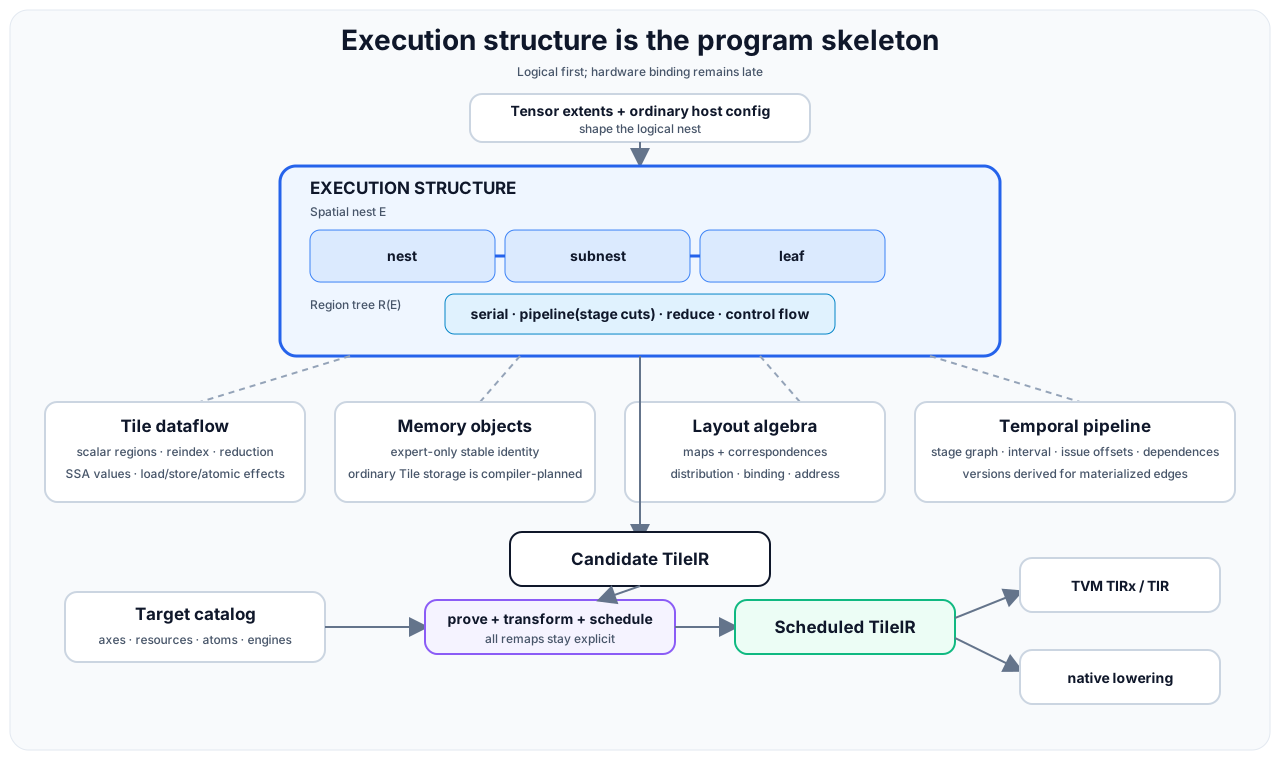
Execution is declared first; data, resources, mappings, and target choices attach to it through typed relationships.
The canonical executable C++ spelling is included from the same source as the C++20/C++23 capture tests. FP32 is used here to match the current tested native bridge; additional element types do not change the access convention.
struct GemmConfig {
    uint32_t block_m{8u};
    uint32_t block_n{8u};
    uint32_t block_k{8u};
    uint32_t window{2u};
};

// Host configuration is captured normally. Each capture/JIT with a different
// configuration records a new TileIR candidate, with no symbolic meta-DSL.
auto make_gemm(GemmConfig cfg) {
    return tile_kernel("gemm", [=](TensorView<const float, 2> A,
                                   TensorView<const float, 2> B,
                                   TensorView<float, 2> C) {
        auto gm = axis("block_m", ceil_div(A.extent<0>(), cfg.block_m));
        auto gn = axis("block_n", ceil_div(B.extent<1>(), cfg.block_n));
        auto kt = axis("k_tiles", ceil_div(A.extent<1>(), cfg.block_k));
        auto m = axis("m", cfg.block_m);
        auto n = axis("n", cfg.block_n);
        auto k = axis("k", cfg.block_k);

        for (auto &nest : parallel(shape(gm, gn))) {
            auto m0 = nest.index(gm) * cfg.block_m;
            auto n0 = nest.index(gn) * cfg.block_n;
            auto acc = zeros<float>(shape(m, n));

            for (auto &step : nest.pipeline(shape(kt), {.window = cfg.window,
                                                        .interval = 1u})) {
                auto k0 = step.index() * cfg.block_k;
                step.stage("load");
                auto a = A[coord(m0, k0), shape(m, k)];
                auto b = B[coord(k0, n0), shape(k, n)];

                step.stage("compute");
                acc = mma(a, b, acc);
            }

            C(coord(m0, n0), shape(m, n)).store(acc);
        }
    });
}
Important properties of this surface:
There is no explicit builder parameter. A scoped current builder records the program, as in the Luisa SIMT DSL.
for (auto &nest : parallel(...))andfor (auto &subnest : nest.parallel(...))make spatial hierarchy and lexical scope the same visible C++ structure. They do not say block, warp, lane, SIMD, or vector.The outer spatial nest supplies an anchor context; the innermost enclosing
parallelsupplies the default frontier. Data dependencies, explicit child coordinates, and the assigned value constrain the final anchor. Inner nests may read and update ancestor values and resources. A collective update is one logical operation, not a whole-value write duplicated for each physical participant. Independent logical instances obeyparallel’s non-interference contract; users do not need to supply an exact-cover proof. The compiler must preserve update regions, snapshots and completion when choosing a mapping. Current capture still rejects ancestor assignments inparallel; that is an implementation gap, not a language restriction.serial,pipeline, andreducealready infer Scalar and Tile carried state.outer.index(...)resolves against that Nest’s own ancestor path, never against an active descendant. Nested positional shapes may reuse dimension identities without changing an explicitly named parent’s coordinate.parallel,serial,pipeline, andreduceare the complete core structured-region vocabulary. They share one range-for capture protocol but have distinct spatial, temporal, and algebraic semantics.for (auto &k : subnest.pipeline(iterations, policy))creates one temporal producer/consumer pipeline persubnest;k.index()is the logical iteration coordinate.Data/effect dependences infer a producer/consumer stage graph. Optional
k.stage("name")cursor cuts partition the nearest enclosing pipeline body into subregions that can later bind to distinct participant subsets or engines.The loop body directly assigns
acc. Capture analysis constructs the hidden loop-carried SSA edge.A load produces a Tile SSA value. A cross-stage use already gives the resource planner enough information to keep, materialize, version, fuse, or recompute it; ordinary pipeline staging does not require explicit
Memory.Addressable memory is explicit only when stable storage identity is part of the intended schedule.
Ordinary host configuration values create ordinary JIT variants. A symbolic staging language is not required for autotuning.
Kernel arguments belong in the lambda signature, exactly as they do in Luisa’s
SIMT DSL. tile_kernel(lambda) retains the C++ definition; it does not invoke
it before concrete argument metadata is available. On a JIT specialization,
the frontend creates parameters in signature order, attaches the concrete
shape/stride metadata to their proxies, and invokes the lambda to build one
candidate TileIR. axis(name, extent) gives logical dimensions kernel-local
identities; shape(axis...) relates operands without mutating the external
views. Numeric shape(extents...) supplies positional dimensions. No input,
output, GemmSpec, or symbolic integer language is needed in the body.
TensorView<const T, R> optionally prohibits writes through that parameter.
TensorView<T, R> permits reads and writes; it does not promise that the
parameter is an output. Actual read/write effects come from IR uses, not a
second direction declaration. Constness does not imply non-aliasing.
The signature adapter is implemented for dense TensorView parameters. Its
low-level definition.capture(tensor_shape(...), ...) entry lets IR tests and
compiler bridges provide metadata without a runtime device adapter. It runs
the definition afresh for each call. Every executable Tile DSL test and POC
uses this signature entry; the former define/input/output/inout helpers
and their Buffer proxy have been removed, with no compatibility surface.
The opt-in luisa/tile/runtime.h adapter can compile a captured kernel through
tile::compile(device, kernel) and dispatch it on an ordinary Runtime Stream.
Automatic argument-shape capture at invocation, arbitrary strided views, and
scalar signature parameters remain separate implementation work.
API evolution
Tile has no backward-compatibility requirement. When a new API replaces an old one, migrate its implementation, tests, examples, benchmarks and documentation together, and remove the old entry points. Do not retain compatibility aliases, forwarding wrappers or version-dependent legacy behavior. Keep syntax because it expresses the intended model, not because existing callers depend on it.
Immutable benchmark snapshots remain historical evidence, not supported API surfaces. Supporting the same current syntax across C++ language versions is also distinct from retaining an obsolete Tile API.
Non-negotiable separations
The following are different IR concepts even when a backend eventually folds them into one instruction:
Concept |
Question |
TileIR representation |
|---|---|---|
Logical value |
What tensor elements exist? |
Tile SSA value and logical space |
Execution hierarchy |
Which nested program instance invokes and participates? |
|
Execution binding |
How do logical instances map to a machine? |
|
Value distribution |
Which participant and local slot hold an element? |
|
View |
Which coordinates of an existing object are named? |
|
Memory |
Which addressable object has stable identity? |
|
Reduction |
Which contributions update each result, in what order and with what permitted regrouping? |
ordered domain, grouping, update and optional merge contract |
Materialization |
Which virtual SSA edges require storage? |
compiler-owned materialization and version plan |
Resource instance |
Which per-program physical allocation is selected? |
|
Address |
Which byte inside that allocation is selected? |
|
Pipeline |
When is an operation issued and which version is live? |
schedule and version maps |
Atom |
Which participant and slot feed an instruction operand? |
operand |
A register fragment is normally a distributed SSA value, not a memory scope.
A logical hierarchy level is not a hardware scope. A view is not an allocation.
A pipeline stage is not automatically a ring-buffer index. A reduction tree is
not automatically a warp collective, and a cross-stage value is not
automatically a user-declared Memory.
Surface convenience is not primitive proliferation
Three extension layers must stay distinct:
Layer |
Purpose |
Examples |
|---|---|---|
C++ Tile library |
Pleasant reusable algorithms that expand to core regions and SSA |
GELU, matmul/einsum, convolution, softmax, Top-K, sort, scan |
TileIR core primitive |
Irreducible semantics, effect, or transformation contract that cannot be reconstructed |
parallel, serial, pipeline, reduce, scalar region, |
Target atom |
Proved replacement for a matched core subgraph on one capability set |
target MMA implementation, async copy, shuffle reduce, sort network, tensor-memory operation |
A library call may remain as an in-memory call temporarily for compile-time and diagnostic quality, but it must have a target-independent expansion into the core. It is not a new semantic entity merely because the C++ spelling is short.
Adding a target feature normally adds an atom contract and a rewrite pattern, not a frontend or Candidate TileIR primitive. A proposed core primitive is accepted only if at least one of these is true:
its observable semantics or effect cannot be represented by composition;
expanding it would lose information required to prove legality;
it introduces an irreducible synchronization, convergence, or resource protocol shared by more than one target family.
Faster matching, prettier syntax, or one vendor instruction is insufficient. If later evidence justifies promotion, the library definition remains the reference semantics and differential oracle for the new primitive or atom.
mma(a, b, c) is the deliberate exception to the usual “keep tensor
operators in the library” rule. Expanding it immediately into multiply and
reduce loses the fused accumulation contract, accumulator precision and
rounding policy, and the cooperative operand-layout relationship needed to
prove legal use of matrix hardware across GPU and accelerator families. The
Candidate operation is portable semantics; a target MMA instruction remains a
Machine TileIR atom that must refine those semantics and satisfy concrete
participant and layout contracts.
The admission test applies to region kinds too. The current four survive for different reasons; there is no fifth catch-all execution entity:
Region |
Information that would be lost by expanding it away |
|---|---|
|
Independence, logical participant product, and the spatial prefix used by ownership and distribution |
|
The canonical counted iteration domain and mandatory recurrence order; it is the one structured loop primitive rather than a second generic loop hierarchy |
|
Finite stage segmentation, dependence distances, and permission to overlap iterations; flattening to |
|
Contribution grouping, update/merge and numerical policy; unordered trees by default, explicit restrictions for ordered trees or strict folds |
Distribution is a map, not a region. A memory resource is an addressable object, not a region. A pipeline stage is a segment of one pipeline, not an execution level. These negative decisions are as important as the four positive ones.
The initial reference library has explicit desugarings:
Library surface |
Core expansion |
|---|---|
lifted |
generic scalar SSA region over a dimension-identity join |
|
captured reduce region with generated state update |
|
infer conventional trailing matrix dimensions, create a zero result, then |
general |
reindex/broadcast, elementwise multiply, reduce; a schedule may retile it into |
convolution / pooling / normalization |
views plus elementwise and reduce regions |
|
pure SSA Tile extraction in a scalar map; gather adds single-axis index-Tile selection and fallback |
|
indexed explicit stores with an independence contract, or an explicit combine/order contract; no public scatter/atomic API yet |
|
load/store edge, optionally recognized as a transfer atom |
|
indexed Tile plus bounded merge-and-truncate reducer |
|
compare/ite/reindex networks or structured radix/merge library |
|
reindex/gather plus elementwise combine; blocked library versions use serial carry |
histogram (design/library direction) |
indexed contribution grouping and explicit reduction/effects |
This table is a test obligation: the target-independent expansion must run in the TileIR interpreter, and every atom replacement is checked against it.
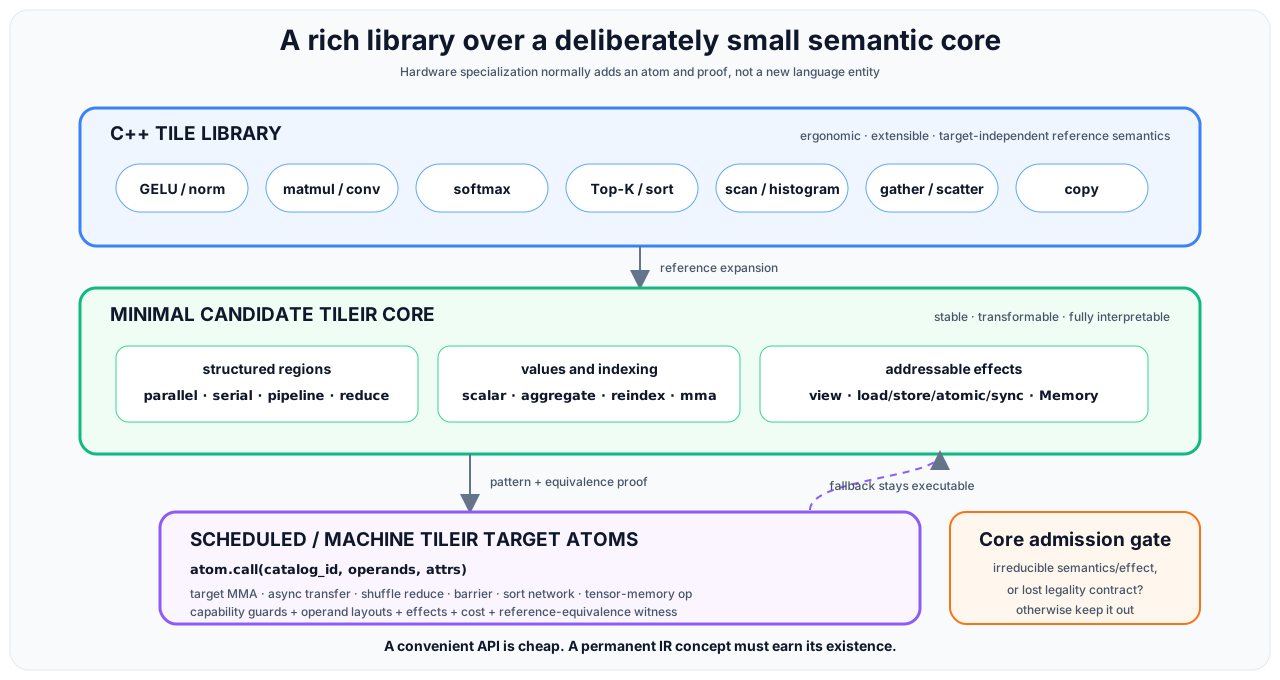
Surface convenience, semantic primitives, and hardware atoms evolve at different rates; keeping them layered prevents permanent IR bloat.
Compiler references
Documentation has one owner per question:
Question |
Owning reference |
|---|---|
What does a source program mean? |
This overview and the execution, values, memory and pipeline references |
Which transformations and plans are legal? |
Internals: calculus, TileIR and planner |
What is implemented and measured? |
Performance: implementation coverage, validation and results |
What came from prior work and what remains a research hypothesis? |
Internals related work; detailed Chinese research notes under |
Per-reduction policies, with unordered_tree as the source default, are
implemented as C++ overloads and typed TileIR fields; see
values. TIRx and XIR honor
explicit order restrictions. Backend candidate selection is separate from this
permission. General custom lift/merge contracts and their proof/diagnostic
machinery remain extensions, not a consequence of adding an order enum.
TileIR and capture, TIRx export, and planning are implementation references, not additional parts of the C++ surface. The architecture decisions retain the original design checklist; current work and measured results live in implementation coverage and performance.