TileIR representation and capture
This page owns in-memory IR, capture dataflow, ownership and verification. The mutable SSA core is implemented; the full analysis inventory, region-form pipeline stages and general Scheduled/Machine forms below are extension contracts, not an inventory of finished passes. See implementation coverage.
TileIR as a thin but transformable IR
The current implementation and the target design must not be conflated:
Area |
Implemented representation |
Extension specified here |
|---|---|---|
Mutation |
Managed intrusive lists, SSA uses, typed kinds, structural verifier and basic rewriter/analysis manager |
Dependency-aware analysis invalidation and transactional execution remapping |
Reduction |
Domain, captured state and typed per-operation fold/tree policy; unordered-tree default; bridge-local merge recognition |
General typed lift/merge, law provenance and exceptional-value contracts |
Pipeline |
|
Stage subregions, explicit dependence/version protocol and modulo schedule |
Scheduling |
Bridge-local mapping, matrix and reduction plans |
Common Scheduled/Machine verifier forms and generic target atom calls |
Primitive semantics and their refinement rules live in the
execution calculus. verify(module, target) checks structure,
types, use/ownership relations, state flow and explicit target constraints;
it is not a general proof of the source program’s parallel independence.
Passes may rely on semantic contracts while validating newly introduced
mapping, storage and synchronization. Optional invocation/debug validation is
separate from the normal optimization admission path.
In-memory structure
TileIR borrows the useful structural properties of LLVM IR and Luisa XIR, without importing MLIR:
Module,Function,Region,Block,Operation;explicit
ExecStructure, stableExecLevelidentities, and prefix cuts;typed SSA
Valueand explicitUselists;operations own zero or more regions;
interned immutable
Type,Dim,Space,IndexSet,LayoutMap,LayoutCorr, and attributes;typed
ExecRemapobjects carrying old/new structures, active domains, prefix factorizations, and transform provenance;stable source locations and diagnostic provenance;
explicit successors and block arguments;
verified parent/ownership relationships;
an
IRRewriterfor insertion, replacement, region movement, erasure, and transactional execution-structure remapping;an
AnalysisManagerwith dependency declarations and invalidation;interfaces for effects, layout inference, tiling, atoms, and target export.
Serialization is one consumer of this model. It is not the in-memory design and does not define transformability.
Ownership and mutation contract
The mutable spine follows Luisa XIR’s managed intrusive-list model, adapted for multi-result operations:
Module
└─ FunctionList                         managed intrusive, ordered
   └─ Function
      └─ Region                        single owner
         └─ BlockList                  managed intrusive, ordered
            └─ Block
               └─ OperationList        managed intrusive, ordered
                  └─ Operation
                     ├─ operand slots  vector<ManagedPtr<Use>>, ordered
                     │                    │
                     │                    └── intrusive link ──> Value::UseList
                     ├─ result Values  single owner, stable address
                     └─ child Regions  single owner
Function, Block, and Operation need stable identity plus constant-time
detach, insertion, and movement, so their ordered parent sequences are doubly
linked managed intrusive lists. Use needs stable identity and constant-time
unlink but no semantic order in the defining value’s user set, so it is a
managed intrusive forward node. The ordered operand slots retain a managed
reference to each Use; the defining Value::UseList retains another reference
only while the user operation is linked into TileIR.
This linkedness rule is part of IR semantics:
Operation::remove_self()first detaches all operand uses and returns a managed ownership handle;insertion restores the parent pointer and reattaches those same
Useidentities;set_operandmoves oneUsebetween value lists in constant time;replace-all-uses walks only the old value’s use list, never the module;
erasure is legal only when every result has no linked uses, then automatically removes all incoming use-def edges;
a detached operation is outside the IR and therefore does not participate in liveness, use counts, verification, or analyses until reinserted.
The verifier checks both relations for every operand: its logical
Use::value() and the physical identity of the Value::UseList that owns its
intrusive link. It also checks ordered parent membership, parent pointers,
result definitions, unique IDs, and lexical dominance. IRRewriter wraps these
mutations and invalidates cached analyses.
Not every object is intrusive. Region and result Value have exactly one
structural owner and never need sibling splicing; immutable types, dimensions,
layouts, and attributes are shared/interned values. Keeping those simple avoids
turning TileIR into a general object graph while preserving the operations that
real transformation passes need.
Minimal operations
The Candidate semantic core needs only the following operation families:
Family |
Only primitive form |
|---|---|
Control |
function, call, return, block argument, branch, conditional, region yield |
Structured execution |
|
Aggregation |
|
Pure values |
constant, tuple/aggregate, generic scalar SSA region lifted over dimension identities, reindex, semantic |
Addressable effects |
|
This is an operation inventory, not a list of every IR class. Dimensions, layouts,
anchor/frontier constraints, bindings, reducer laws, source locations, and
remap proofs are immutable attributes or analysis/proof objects. Frontend Tile
variables are capture bookkeeping and are promoted immediately to block
arguments and SSA values. In the proposed region form, k.stage() becomes
pipeline subregion boundaries, not a lasting executable marker. Current capture
does use OperationKind::STAGE; removing it is an IR normalization extension,
not an implemented fact. subview, reshape, transpose, broadcast, slicing,
padding, and swizzle are constructors for the one view/index-map form, not
opcodes. Repartition is an explicit Scheduled TileIR realization record and
cost boundary, not Candidate value semantics.
The proposed Machine TileIR adds one parameterized operation form:
atom.call(catalog_id, operands, layout/effect/protocol attributes)
    -> values and protocol tokens
Target MMA instructions, asynchronous transfer, shuffle collective,
barrier/event, sort network, and tensor-memory instructions are catalog entries
of that form. The Candidate mma operation is not itself one of these catalog
entries: atom selection replaces it with a target-specific realization only
after proving type, arithmetic-policy, participant, and operand-layout
compatibility. Protocol tokens are ordinary SSA results; resource binding and
capability guards are attributes and verified constraints. A new target
instruction therefore does not require a new C++ construct, TileIR opcode,
visitor method, or serializer enum.
The Candidate core deliberately has no dedicated GEMM, convolution, softmax,
normalization, Top-K, sort, scan, gather, scatter, or copy opcode. Their library
definitions compose the rows above: matmul is zero initialization plus
mma; general einsum is reindex + elementwise multiply + reduce; gather is a
load whose index map is a value; scatter is an indexed store or atomic; and
copy is a load/store dataflow edge. Scheduled or Machine TileIR may replace a
proved subgraph with a registered target atom referenced by a stable ID and
verified attributes.
Forms and invariants
The design gives one IR data structure progressively stronger verified forms:
Candidate TileIR: logical hierarchy and semantic operations; some anchors, frontiers, layouts, bindings, distributions, and realizations may be variables.
Scheduled TileIR: execution binding, pipeline schedule, distributions, memory plans, transformed execution structure, and guards are concrete.
Machine TileIR: atom calls, explicit realized transfers/synchronization, and addresses are legal for one target.
These are intended verifier states, not three unrelated object models. The general Scheduled/Machine verification pipeline is not implemented yet.
Proposed reduction contract record
The semantic record belongs on the reduction operation, not in a target-name switch or transient cost annotation. It contains:
the contribution domain, grouping and source order;
state/element types, the typed update and its operand orientation;
incoming seed and, when available, lift/merge and identity;
the resolved regrouping/permutation permission and reference fold direction;
arithmetic and determinism requirements, including exceptional values;
provenance for builtin laws, derived conditions and trusted custom contracts.
Capture resolves an omitted policy to unordered_tree; an explicit local
restriction takes precedence. This order-policy portion is implemented as
Operation::reduction_policy(), separate from bridge-local body matching.
IRRewriter::set_reduction_policy invalidates cached analyses; direct low-level
mutation still requires the pass to invalidate them explicitly. Tree
permission admits the registered reducer’s changed evaluation order, not a
different dtype or arbitrary approximation. Exact algebraic laws remain
distinct from this permission. A default tree update without a compatible
merge should be diagnosed with the alternative of an explicit strict fold by
the proposed general contract checker. Today unmatched bodies remain serial;
only the bounded recognized merge family is admitted to tree lowering.
All bridges consume the same resolved record. Backend options enable candidate families; they cannot strengthen the permission. Changing a contract invalidates its derived placement, protocol and cost summaries. Stable immutable semantic data and revision-keyed analysis side tables keep this distinction transformable, without making a serializable attribute the only source of compiler structure.
Essential analyses
dominance and post-dominance;
liveness across regions and pipeline iterations;
memory effects and alias sets;
layout-map and correspondence equivalence, image/preimage, and proof obligations;
distribution compatibility and repartition cost;
reduction grouping, reducer-law, accuracy/order, and placement legality;
ordering-contract, logical permutation, Top-K state, and scan legality;
execution-prefix ownership and visibility;
execution-remap equivalence and prefix-factorization legality;
resource pressure and occupancy;
dependence distance and modulo scheduling;
guard implication and variant coverage.
Analyses live in side tables keyed by stable IR identities. Transform passes do not stuff transient conclusions into serialization fields.
Capture algorithm
Every surface Tile declaration owns a staged variable identity. Reading it
records the current definition; assignment records a new definition. When a
structured region closes, its builder compares the incoming and outgoing
definition environments.
For a pipeline or loop it computes two related sets:
loop_carried  = read_before_definition_inside
              intersect written_inside

region_result = written_inside
              intersect live_after
For an execution nest it also computes:
ancestor_update = written_inside
                intersect declared_in_ancestor_scope

Assembly : ChildPrefix x ChildFragment -> AncestorLogicalCoord
For a reduction region it computes:
reduction_state = written_inside
                intersect declared_outside_region

next_s = Update_s(incoming_s, reduction_coord, captured_values)
Capture first verifies typed reaching definitions, region state flow and the pure state-update boundary. Recognition of a merge is a separate obligation: tree policies, including the proposed default, need a compatible lift/merge under their arithmetic contract. An explicitly selected strict fold can retain a pure update without any parallel merge law. Merely reading the incoming state does not prove associativity; conversely, an update may ignore it on a path without making a strict fold structurally invalid.
Independent states can form a product only with each component’s permissions
preserved; coupled states require a joint contract. Disjoint per-coordinate
assembly belongs in parallel, not an inferred last-writer-wins reduction.
General ordered effects and observable prefixes remain serial or scan
semantics. This is the target contract, not a claim that current capture
already implements these algebra and policy checks.
An inner scope may read or write an ancestor Tile. Assembly records the
actual update footprints and joins their payloads; partial coverage retains
the incoming value at untouched coordinates, and old SSA snapshots remain
unchanged. Ordinary parallel supplies the cross-instance noninterference
contract, rather than requiring capture to prove it again. Updates within one
instance retain their local order; overlapping cross-instance updates need an
explicit supported combiner, not an implicit last writer or inferred replica
agreement. Mutable Memory effects instead use MemorySSA, alias, and
synchronization rules. The compiler must validate that its chosen assembly
implementation preserves these semantics; an inconclusive overlap analysis
does not itself make the source program invalid. See
ancestor access
for the current capture and IR implementation gaps.
These are control-flow data-flow sets, not textual scans:
read_before_definition_inside means a read not dominated by an in-region
definition on every reaching path. Nested conditionals and early exits are
therefore handled by the same definite-assignment analysis.
A recurrence may be loop-carried even when its final value is dead after the
loop; only region_result becomes externally visible SSA. Values read but not
written are captures, and values written without a prior read need no initial
operand unless control-flow merging requires one.
The frontend temporarily permits variable reads/writes. The first mandatory canonicalization pass promotes them to region arguments and SSA results.
The current straight-line capture uses a temporary forwarding definition for each live C++ variable at temporal-region entry. At region exit, a mutated variable resolves to its own body argument; an unchanged variable resolves to its incoming definition. The forwarding definitions are then removed, so the stored TileIR remains SSA without an additional public operation kind:
before loop:  a -> %initial, b -> %initial, snapshot -> %initial
inside loop:  a -> %a_in,    b -> %b_in,    snapshot -> %initial
Sharing an initial definition does not merge variable identities. In
particular, auto old_a = a; ...; b = old_a; yields %a_in, not %initial.
The builder installs the yield before resolving forwarding definitions, and
also rewrites live C++ handles before erasing them. The implementation
conservatively carries every mutated incoming variable; later liveness and
canonicalization can eliminate redundant state. CPU and Metal tests cover
Scalar and Tile snapshots, zero/one/many iterations, and nested pipelines.
The proposed pipeline and nested partial update become conceptually the following. This is an update/join design sketch, not currently accepted IR; the source’s explicit logical slice determines the patch, not an implicit hardware lane or a difference between the old and new values:
%acc1 = exec.parallel %subnest_shape init(%acc0) {
  ^subnest(%subnest_coord, %entry_acc0):
    %origin = ... explicit logical coordinates from %subnest_coord ...
    %acc_fragment = tile.slice %entry_acc0, %origin, %patch_shape
    %next = exec.pipeline range(...) init(%acc_fragment) {
      ^body(%k0, %acc_in):
        %a = load ...
        %b = load ...
        %updated = tile.mma %a, %b, %acc_in
        yield %updated
    }
    yield.updates result[0] (payload = %next, origin = %origin, ordinal = 0)
} join_updates(preserve_untouched = %acc0)
Every child starts with the same entry snapshot; it does not consume the
previous child’s result. Patch payloads and origins are tracked SSA operands.
After the region closes, the surface handle acc denotes %acc1, while prior
snapshots still denote %acc0. A child reading a coordinate it has not itself
updated reads its entry value, without requiring an explicit old alias.
Conditional assignment constructs merge values. A verifier rejects a value that is not definitely assigned on every required path, or carries the old definition when that is the declared semantics.
Shared SSA preserves a resource-planning choice
A Tile SSA definition with several consumers is one logical value. That fact must survive canonicalization and structural bridge export because erasing it by cloning the producer is irreversible. It does not mean that the source declared an addressable allocation or that every backend must store the value.
For a pure definition %v = f(...), target planning may choose among:
recompute(%v, use)     inline f at selected consumers
retain(%v)             keep it in distributed registers/fragments
materialize(%v, R)     assign a compiler-owned resource, layout and lifetime
The choices are equivalent only after checking purity, effects, aliasing,
layout correspondence, active participants and the target arithmetic policy.
materialize additionally needs an ownership map, address map, lifetime,
capacity proof and legal target access. A later pass may still inline a
preserved pure definition; it cannot reconstruct sharing that structural
lowering already destroyed.
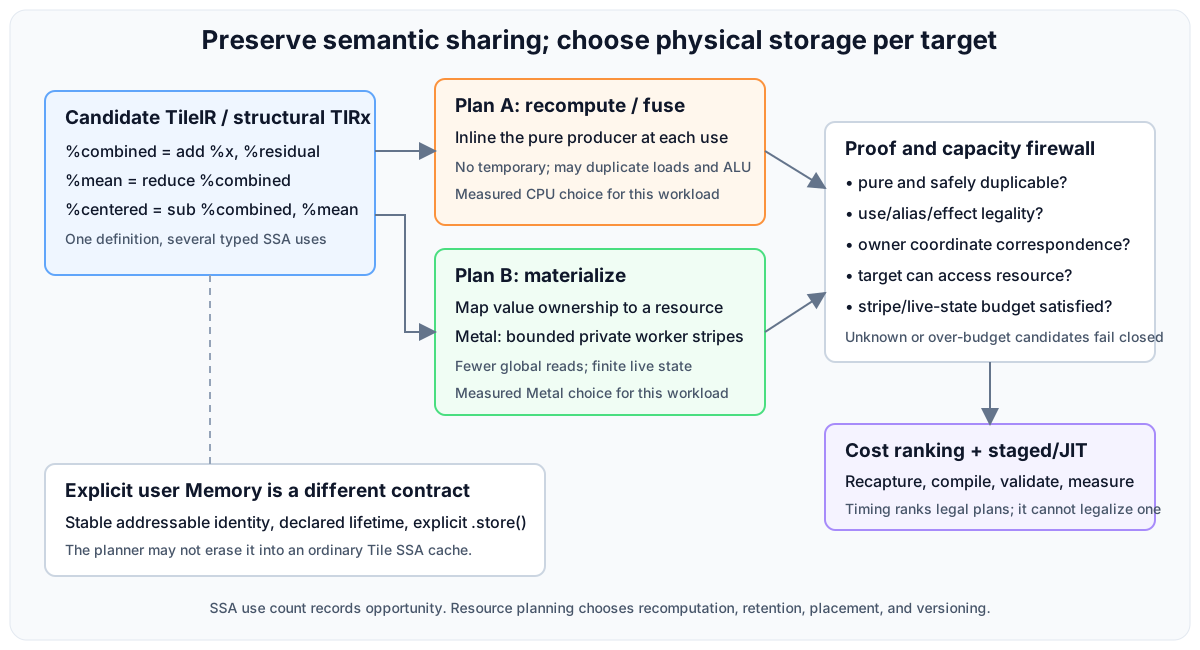
Sharing is semantic information. Storage, placement and recomputation are target-dependent resource decisions.
The implemented TIRx bridge therefore preserves every pure multi-consumer
Tile by default. Its EXPENSIVE_ONLY mode is an explicit diagnostic/JIT
candidate that keeps shared transcendentals but recomputes cheap arithmetic.
The Metal row-program mapper can realize a preserved value as a bounded
worker-private stripe after proving ownership; LLVM may instead profit from
recomputation and fusion. Both modes keep the same Candidate TileIR semantics.
This rule also explains why compiler-created materialization is not surfaced
as memory<T>(...). Manual Memory states that stable addressable identity is
part of the requested schedule. It cannot be silently recomputed and every
write remains an explicit effect.
Required verifier invariants
Before backend export, at minimum verify:
Every layout composition has matching domain/codomain spaces.
Every
ParallelMapor temporal child map is total on its active domain, preserves the required parent projection, and has no escapedExecScopehandle.Every pair of nested execution bindings respects the target-scope containment poset and commutes with logical and target ancestor projection; same-scope factorization is capacity- and convergence-safe.
Every semantic operation belongs to an execution region and references existing, ordered prefix cuts.
Every accepted execution remap preserves its active logical domain and factors through all affected anchor, frontier, ownership, and convergence cuts, or carries an explicit equivalent rewrite.
Every operation has
anchor <= frontier, uses only legal ancestor data, and satisfies the selected atom’s participant contract.Every distributed value covers the required logical domain exactly, unless replication or masking is explicit.
Every ancestor value updated inside a child nest has a typed update/join representation that preserves its footprints, untouched coordinates, old snapshots, and instance-local order. Cross-instance noninterference comes from
parallel’s contract, or updates use an explicit supported combiner; optional overlap validation is not a mandatory source-level proof.Every reduction has a total grouping map, a type-correct identity/update/ merge contract, counts semantic contributions rather than storage replicas, and uses only reassociations allowed by its policy.
Every sort/selection comparator supplies a deterministic total-order policy for all represented values, including ties, invalid padding, and NaNs; every emitted permutation is total and single-valued on its active domain.
Every Memory resource constraint resolves to a target class whose instance topology and explicit access relation are compatible with its lexical owner, all bound accessing execution scopes, and the performed operations.
Every memory access resolves to one legal resource instance, allocation slice, and in-range address under its predicate.
Descendants access ancestor-owned memory only through valid visibility and synchronization rules.
Explicit pipeline cursor calls form unconditional top-level segment cuts with unique optional names; dependences respect issue time, iteration distance, and synchronization scope.
Ring-buffer versions cannot alias while simultaneously live.
Atom operand layouts match the selected atom contract or an explicit repartition is present.
Specialization guards imply all static shape, alignment, and capability assumptions.
Every candidate family has a legal fallback or explicitly rejects the unsupported input region.