Execution Nests and coordinates
These are language contracts and design extensions, not a promise of complete target support. Use the executable examples for current C++ spelling and implementation coverage for admitted lowering.
The semantic skeleton
This is not an algorithm IR followed by an optional bag of schedule commands. The semantic object is:
TileProgram = (
  SpatialNest E,
  ExecRegions R(E),
  Dataflow G,
  MemoryObjects M,
  Layouts L,
  ReductionAlgebras A,
  TemporalPolicies Pi,
  Constraints C)
E is the open logical spatial hierarchy. R(E) is the structured temporal
and algebraic tree of sequences, branches, loops, pipelines, reductions, and
explicit descents, with each region anchored at a prefix cut of E. Together
they are the execution structure. G contains tile SSA and effects, M
contains only stable addressable identities, L contains maps and
correspondences, A contains typed reducer contracts, Pi contains pipeline
policies, and C contains guards and still-open scheduling choices.
Function arguments, tensor extents, and host configuration may of course be
read before the outer parallel, because they can determine its extents. But every
semantic tile operation belongs to an execution region from the moment it is
captured. Its anchor is already known; only its descendant frontier, value
distribution, target binding, and realization may remain open. There is no
free-floating tile operation that a backend later drops into an anonymous loop
nest.
This does not mean hardware first. parallel, serial, pipeline, and
reduce declare logical execution structure, not blocks, warps, lanes, cores,
threads, or vectors. Hardware mapping remains a late ExecBinding, while a
ReductionPlacement separately factors algebraic axes into participant and
serial coordinates. It means the program’s concurrency, ordering, and
aggregation skeleton is explicit before computation placement or physical
binding is solved.
Compiler-created levels are equally first class. A pass that splits or fuses
the nest creates real ExecLevel objects and an explicit remapping proof;
Scheduled TileIR never hides extra semantic loops solely inside backend codegen.
The precise relationship to Halide
The design keeps Halide’s most important separation: where a value is computed
and where it is stored are independent decisions. In Halide, a
Func is a pipeline
stage and the schedule places its production and storage into a resulting loop
nest with mechanisms such as compute_at and store_at; the official
scheduling tutorial
shows that loop nest as the concrete meaning of a schedule.
The difference here is the direction of construction:
Question |
Halide model |
This Tile DSL |
|---|---|---|
Semantic center |
|
|
Execution structure |
Concretized by scheduling the pipeline |
Present in Candidate TileIR before tile operations are scheduled |
Computation placement |
|
Region anchor plus inferred or constrained frontier |
Storage placement |
|
Owner prefix, then separate resource and address bindings |
Target parallelism |
Schedule transforms such as vectorization and GPU tiling |
Prefix-compatible |
Temporal overlap |
Loop/storage scheduling and folded storage |
First-class issue schedule, dependence graph, and version map |
Distributed tile value |
Expressed through the lowered loop/vector organization |
Explicit |
So the analogy is useful but exact: Halide is algorithm definitions plus a schedule that produces an execution structure; this DSL starts with a logical, transformable execution structure and hangs dataflow, storage, distribution, and time from it. That extra indirection is what permits the same tile program to be rebound to a GPU hierarchy, CPU teams and vectors, or accelerator cores without making any of those machines the language ontology.
Dimensions and spaces
The language has no predefined axis::feature, axis::channel, axis::query,
or even axis::k. Such names would turn neural-network conventions into the
type system. The primitive is a function-local dimension symbol:
Dim       = (identity, optional_diagnostic_label)
DimFactor = (Dim, IndexSet)
Space     = ordered/nested product of DimFactor
identity is fresh and stable within a function. The optional label is printed
in diagnostics only; equality and mapping never inspect its spelling. Extent
belongs to a particular factor/domain rather than the symbol, so the same m
dimension may describe a full tensor extent in one space and a block extent in
another.
The public C++ forms are local and open-ended:
auto [m, n, reduction] = dims("m", "n", "reduction");
auto unnamed = dim();

auto A_mk = A.with_dims(m, reduction);
auto B_kn = B.with_dims(reduction, n);
auto C_mn = C.with_dims(m, n);

auto feature = x.dim<1>(); // obtain an existing dimension by position
with_dims is a checked identity retyping of a view, not a memory operation.
It is needed when separate arguments must share dimension identity; dimensions
already inherited by a subview or Tile need no rebinding. Positional access is
only a way to obtain a Dim handle. All reduction, broadcasting, MMA, view,
and layout rules then compare handles and typed maps, never application-domain
words.
Dimension identities are part of the logical type. Two dimensions of the same extent are not interchangeable without an explicit permutation, reindex, or retyping operation.
A non-rectangular domain is an IndexSet:
IndexSet = {x in Space | predicate(x, parameters)}
The common case has predicate true. Keeping a predicate on the domain is
important for ragged tiles and active participant sets, but a view’s
out-of-bounds behavior remains a separate policy.
A small structured-region calculus
The surface has four core structured-region constructors. They deliberately
share one C++ range-for capture shape, but only parallel extends the spatial
owner hierarchy:
for (auto &nest : parallel(grid_shape)) {
    for (auto &subnest : nest.parallel(
             subnest_shape,
             exec::warp)) {
        for (auto &k : subnest.pipeline(k_domain, pipeline_policy{...})) {
            k.stage("produce");
            // Producer operations.

            k.stage("consume");
            // Consumer operations.
        }

        for (auto &i : subnest.serial(tail_domain)) {
            // Strictly ordered temporal iteration.
        }

        auto sum = zeros<f32>(output_shape);
        for (auto &elem_nest : subnest.reduce(reduction_domain)) {
            sum += contribution(elem_nest.index());
        }
    }
}
The outer free function attaches to the implicit kernel root. Every member call
names the semantic parent of a child, without becoming a builder prefix for
ordinary operations. nest, subnest, k, and i are user-chosen variable
names for non-copyable scope handles, not predefined hardware roles. The
canonical examples deliberately reserve tile for data Tile<T, R> and tiled
tensor views, so an execution node cannot be mistaken for a memory level.
Execution coordinates are explicit: nest.index(axis) projects a named logical
axis, and nest.index() is available when that nest’s own domain has rank one.
These are logical iteration coordinates, not memory accesses or hardware thread
IDs. Nest has no operator[]; the A[origin, shape] syntax is reserved for
loading a Tile from a tensor view.
Constructor |
Structural meaning |
Ordering guarantee |
Changes spatial participant prefix? |
|---|---|---|---|
|
Independent logical child instances; policy may constrain its logical map or target scope |
No order between distinct active children |
Yes |
|
Repeated temporal child region |
Total order |
No |
|
Repeated producer/consumer stage graph |
Dependence partial order; iterations may overlap |
No |
|
Algebraic fold region whose outer Tile states are inferred from body updates |
Reducer order; may become a tree, loop, or hybrid |
No |
Independence is a semantic contract, not a hint asking the compiler to
rediscover it through alias or dependence analysis. parallel instances may
be serialized, interleaved, or packed into SIMD lanes without imposing a
relative order. Required coordination must be explicit in the program’s
operations/contracts; choosing a fortunate serial order cannot supply it.
The same principle applies to independent element domains of Tile operations.
What lowering must check is its own realization: coordinate coverage, layout
and resource constraints, storage reuse, and target capabilities. It must not
reinterpret an inner serial/reduction recurrence as another independent axis.
Ordering strength and sibling scopes
The primitives do not form one enum-ordered strength chain. On the same
events under the same assumptions, adding ordering edges restricts the
available schedules: an independent parallel domain has no inter-child
edges, a pipeline has a partial order, and a serial domain has a total order.
But parallel also requires noninterference, whereas a serial recurrence need
not. Reduction adds grouping, update/merge and regrouping permissions rather
than just another order.
See the formal distinction.
A source kernel may contain a sequence of scopes. For example, using the existing range spelling:
for (auto &p : parallel(shape(programs))) {
    auto origin = coord(p.index() * width);
    tmp(origin, shape(elements)).store(f(x[origin, shape(elements)]));
}
for (auto &p : parallel(shape(programs))) {
    auto origin = coord(p.index() * width);
    y(origin, shape(elements)).store(g(tmp[origin, shape(elements)]));
}
for (auto &step : serial(shape(iterations))) {
    // An ordered phase may follow independent phases in the same function.
}
This is illustrative code: f, g, dimensions and arguments stand for the
application. Sequential composition initially orders the phases; it does not
make the second phase another child of the first. Fusion is a compiler
transformation, not a new source primitive. Pointwise producer/consumer pairs
can fuse after checking their cross-phase dependences. A consumer of all
producer results retains the required completion boundary.
The full composition design permits one source invocation to lower to one or several physical launches. General automatic sibling fusion and multi-launch Tile Runtime plans are not implemented yet. A device-wide boundary must not be replaced by a threadgroup barrier. The scope calculus and Runtime extension define the future single-device and distributed interpretation.
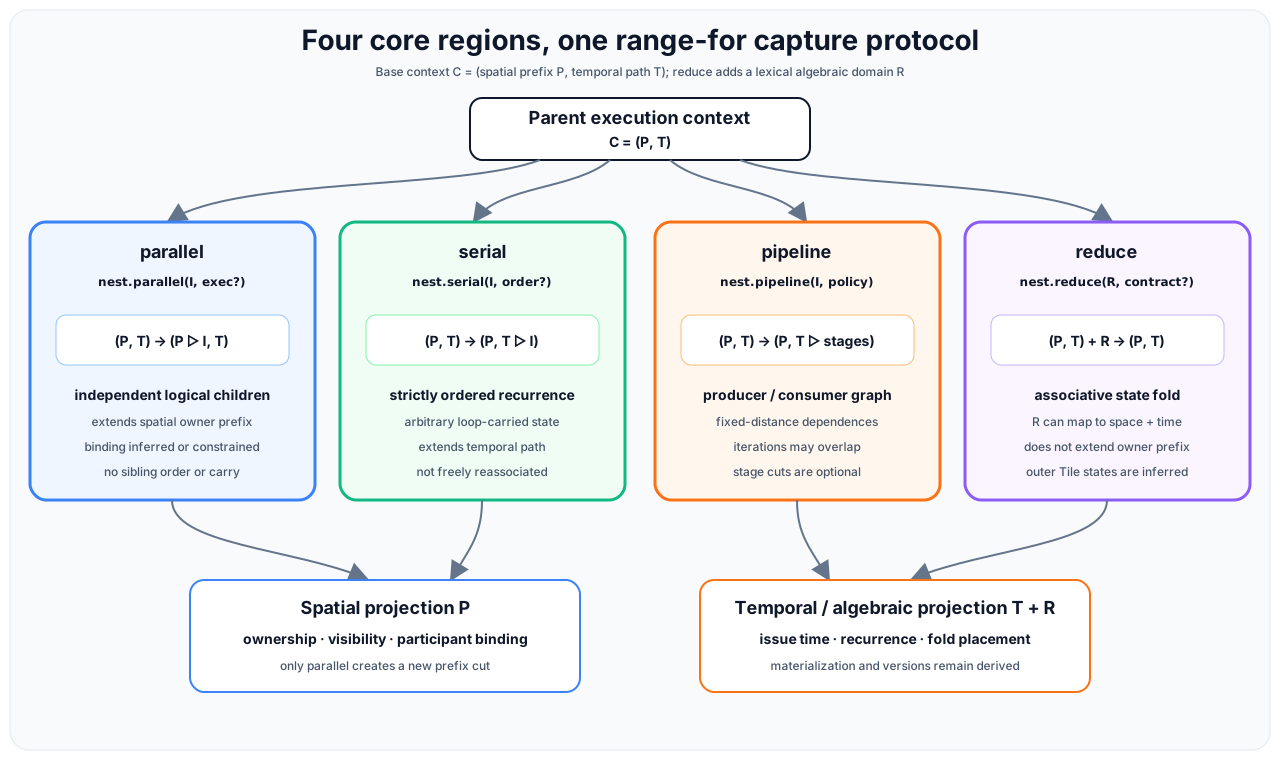
The four regions separate independent space, ordered time, pipelined time, and contribution aggregation without naming hardware. Reduction policies distinguish tree permission from an explicitly ordered fold.
The second parallel argument is optional expert control, not part of the
logical domain. Omitting it leaves binding open. Common concise constants are
exec::cluster, exec::block, exec::warp (exec::subgroup is its portable
alias), exec::thread, exec::core, and exec::vector. A target maps each
supported constant to its execution topology and rejects an unavailable one;
an extensible catalog token remains available for unusual accelerators.
exec::layout(map) separately constrains the logical child map. These
constraints are retained in Candidate TileIR and participate in variant guards
and legality diagnostics.
Target execution scopes form a containment partial order, not the numeric
order of the convenience constants. Let contains(h_parent, h_child) mean that
one instance of h_parent owns the relevant instances of h_child. For every
pair of bound logical levels Ej and Ek, j < k, the solver must prove:
contains(bind(Ej), bind(Ek))

target_parent_j^k o bind_map_k
  = bind_map_j o logical_parent_j^k
Thus block -> warp -> thread can be legal, warp -> block is not, and two
incomparable scopes on a heterogeneous accelerator cannot be nested merely
because their enum constants have an order. Unbound intermediate levels inherit
upper and lower constraints from their nearest bound ancestors and descendants.
Several logical levels may bind to the same hardware scope only when their
combined coordinate map factors inside that scope and satisfies cardinality,
uniqueness, and convergence constraints. Diagnostics cite both conflicting
nest sites and the missing target-topology relation.
This policy binds execution, not storage. It does not force every value in
the body to materialize at that target scope. Virtual Tile SSA edges are still
planned independently, and distinct explicit Memory objects declared under the
same subnest may bind to different resource kinds. A value-materialization or
Memory-resource constraint therefore targets that value/object in the schedule;
it is never a blanket field of parallel.
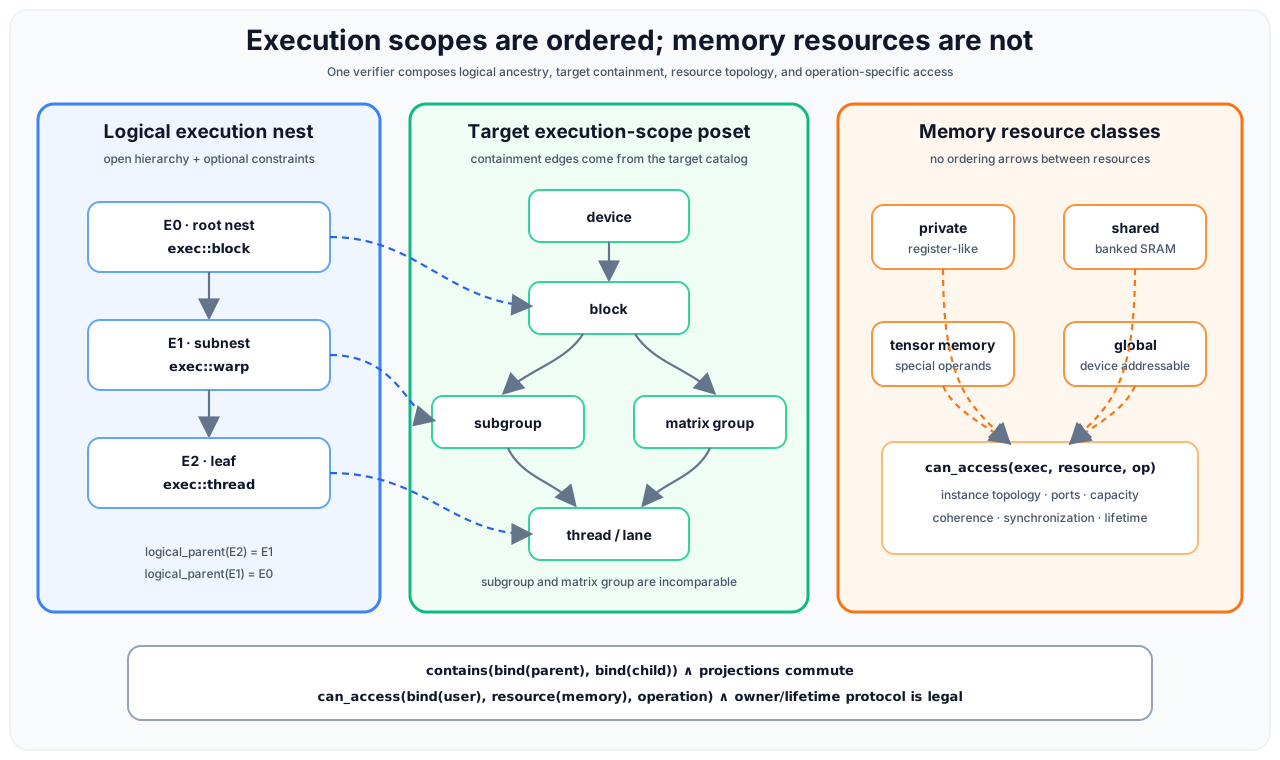
Execution ancestry has an order. Memory resources remain independent classes connected to execution by topology and operation-specific accessibility.
k.stage(optional_name) is not another nest or a runtime operation. It
advances the frontend capture cursor to a new logical phase in that k
pipeline. The first call begins stage zero; each later call closes the preceding
segment and begins the next. The design represents these as ordered stage
subregions; current capture records STAGE markers instead. The name is an
optional compile-time label; identity is local
to the owning pipeline. The iteration coordinate still comes from k.index().
reduce is a nest-like region, but not a new execution or memory level. Its
range-for value is a non-copyable Nest handle with index(), just like the other
three regions; it never changes type into an accumulator or an input Tile.
The compiler infers reduction states from outer Tile variables updated by the
body. The default is unordered_tree: a compatible reducer contract
lets scheduling factor contributions into participants, serial steps and a
merge tree, with regrouping and permutation allowed. Users explicitly select
an ordered tree or strict left/right fold when needed. Strict folds need no
parallel merge. There is no public loop-result accessor.
Reduction semantics separates
the implemented per-region order policy from the still-proposed general
lift/merge contract system.
This set is intended to cover the structured static-control kernel fragment
specified in the calculus;
a general completeness proof is not yet established. Spatial products and
hierarchy factor into
parallel; a temporal total order is serial; a periodic partial order with
finite producer/consumer phases and fixed-distance loop-carried edges is
pipeline; and contribution aggregation with a stated fold/tree contract is
reduce. Any
finite acyclic phase graph can be topologically staged, while the IR retains the
actual dependence DAG rather than mistaking textual order for an all-to-all
barrier. Dynamic $if, $switch, and $while remain ordinary Luisa
control-flow regions, not execution-nest kinds. Truly dynamic task creation or
host-visible queues would be a separate future facility, not silently
overloaded onto parallel.
Several tempting constructs are therefore derived rather than primitive:
source block order already represents a sequence of statements;
split, fuse, reorder, unroll, vectorize, and software-threading are execution transforms or policies;
block, warp, lane, core, SIMD, and tensor-core placement are target bindings;
elementwise operators lift through one generic scalar region;
mapis its custom-lambda surface;general einsum/contraction, convolution, scan, gather, scatter, copy, sort, and Top-K begin as library compositions;
matmulis short syntax over the semanticmmavalue operation, and expressionreduce(value, axes, reducer)is shorthand for a reduction region;synchronization is one abstract effect when semantically explicit; inferred barriers, events, and async protocol tokens are scheduled realizations or results of target atoms, not new region kinds.
Formally, every lexical point has a typed execution context:
C = (P, T)
P = spatial participant prefix
T = temporal path, including serial/pipeline iteration and current stage
R = optional lexical reduction path; never a resource-owner prefix

parallel : (P, T) x I -> (P', T)
serial   : (P, T) x I -> (P, T')
pipeline : (P, T) x I -> (P, T') plus a local StageGraph
stage(s) : (P, T')     -> (P, T' ▷ s)
reduce   : (P, T) x (R, Reducer?) -> (P, T), with body context R
           and captured outer Tile updates as inferred states
This typing is the important decoupling: memory ownership and execution
binding project from P; liveness, recurrence, pipeline issue time, and
version selection project from T; reduction legality and factorization
project from R. A pipeline can reorganize time without inventing a memory
level, a reduction can move between space and time without becoming a memory
owner, and a spatial hierarchy can be rebound without changing either
producer/consumer or reduction semantics.
All four ranges use the same one-pass capture technique as Luisa’s
dynamic_range. They do not enumerate logical coordinates on the host:
begin / dereference : create the typed region op, push it, return Scope&
increment           : close captures, pop the region, mark iterator done
compare to sentinel : true only before that single capture pass
destructor           : close an open region during host stack unwinding
Thus braces, variable lifetime, and indentation accurately show the execution
tree, while extents remain staged properties of generated code. A native C++
break or continue only affects capture and is diagnosed; device control
flow uses the ordinary DSL constructs. A generation check likewise diagnoses
an escaped scope reference.
The spatial constructor has a concise default and an explicit coordinate-map form:
for (auto &child : parent.parallel(child_shape)) { /* append axes */ }

for (auto &child : parent.parallel(child_shape, child_exec_layout)) {
    /* reshape, permute, or swizzle logical child coordinates */
}
For parent spatial prefix P, raw child index set I, and child prefix P',
the second form supplies a typed nest map:
ParallelMap : P x I -> P'
parent_projection o ParallelMap = project_P
The default is ParallelMap(p, i) = append(p, i). The preservation equation
makes ancestry mechanically checkable. The analogous temporal maps for
serial and pipeline preserve P and append or reorder only temporal axes.
These maps describe execution coordinates only. They do not choose which
tensor elements a value holds, how A/B/C are indexed, where a temporary is
allocated, or which hardware entity runs it. Those remain independent
Distribution, Access/ViewMap, AddressMap, and ExecBinding maps.
Each handle distinguishes its local coordinate from its complete typed path:
subnest.index() = coordinate in I_subnest
subnest.coord() = ParallelMap(nest.coord(), subnest.index())

k.index()       = coordinate in I_pipeline
k.coord()       = append_time(subnest.coord(), k.index())

r.index()       = coordinate in R_reduce
r.coord()       = append_reduction(subnest.coord(), r.index())

leaf.index()    = coordinate in I_leaf
leaf.coord()    = LeafMap(subnest.coord(), leaf.index())
A local index is staged and readable only inside its lexical range:
for (auto &subnest : nest.parallel(subnest_shape)) {
    auto s = subnest.index();

    for (auto &leaf : subnest.parallel(exec::infer)) {
        auto w = leaf.index();
        auto parent = subnest.coord();
        auto full = leaf.coord();
        // full is derived from (nest.coord(), s, w).
    }
}
Entering parallel changes the default spatial frontier; entering serial or
pipeline changes temporal context but does not automatically clone a value.
An operation’s anchor is inferred from operand identities, free execution
coordinates, effects, and destination. A value that depends on
subnest.index() requires at least the subnest anchor; per(subnest, expression) is the explicit form when no such dependence makes that intent
evident. Assigning an ancestor-owned value keeps the ancestor anchor and
creates a collective region update. This is one logical update distributed
through the child frontier, not a whole-value write independently replicated
for every participant. Where distinct logical instances contribute partial
updates, parallel supplies their noninterference contract; the compiler does
not require the user to prove it again. The compiler must still preserve the
logical update when constructing its physical fragment mapping. Explicit
cross-instance overlap needs an appropriate reduction or atomic contract.
This is what makes direct
acc = mma(a, b, acc) concise without making ownership depend on C++ spelling
accidents.
Execution is a nest, not yet a layout
For levels E0 ... Ed, the logical execution hierarchy is:
E = E0 ▷ E1 ▷ ... ▷ Ed
Pj = Prefix(E, j) = E0 x ... x Ej
Fiber(E, a, b) = E(a+1) x ... x Eb
▷ preserves level boundaries in addition to forming the product. The
boundaries define ownership, visibility, operation placement, and legal
ancestor projections.
Execution hierarchy and nested layouts are related, with an important type distinction:
the hierarchy is the domain and its factorization;
a layout is a map from that domain to another coordinate space.
Without a codomain there is no layout function yet. Once a hierarchy is bound to a target, the binding is a prefix-compatible family of layouts:
beta_j : Pj -> TargetPrefix_j x SerialAxes_j

for j < k:
  target_parent_j^k o beta_k = beta_j o pi_j^k
Here pi_j^k is logical ancestor projection and target_parent_j^k is the
corresponding target ancestor projection. The deepest beta_d is the full
ExecBinding; retaining the compatible prefix maps prevents a later
transformation from losing hierarchy ownership information.
The maps may split, fuse, permute, serialize, vectorize, or elide logical axes. Consequently no hierarchy constructor is named after a physical parallelism mechanism.
Logical anchor and execution frontier
A collective operation needs two depths, even though its normal surface only mentions the second:
anchor(op)   = a                  one logical instance per coordinate in Pa
frontier(op) = b, where a <= b    operation is distributed through level b
Active(op) is a subset of Pb      execution events that actually participate

participants(op, p) =
  {q in Fiber(E, a, b) | (p, q) in Active(op)}
The frontier defaults to the innermost enclosing parallel range. The anchor is
the least legal prefix satisfying operand/value identity, explicit execution-
coordinate dependencies, effects, and assignment constraints. serial and
pipeline add temporal context without changing that spatial frontier:
for (auto &nest : parallel(grid)) {
    auto acc = zeros<f32>(output_shape); // anchor(acc) = nest

    for (auto &subnest : nest.parallel(subnest_shape)) {
        for (auto &k : subnest.pipeline(iterations, policy)) {
            auto a = load_a(k.index());
            auto b = load_b(k.index());

            acc = mma(a, b, acc);
            // anchor(mma) = nest, frontier(mma) = subnest
        }
    }
}
The existing identity of acc constrains the MMA update to remain one
logical update per nest; the nested scope says how deeply that update is
distributed. It does not duplicate a whole result per subnest. Conversely,
an expression depending on subnest.index(), or an explicit
per(subnest, expression), creates a distinct logical value per subnest.
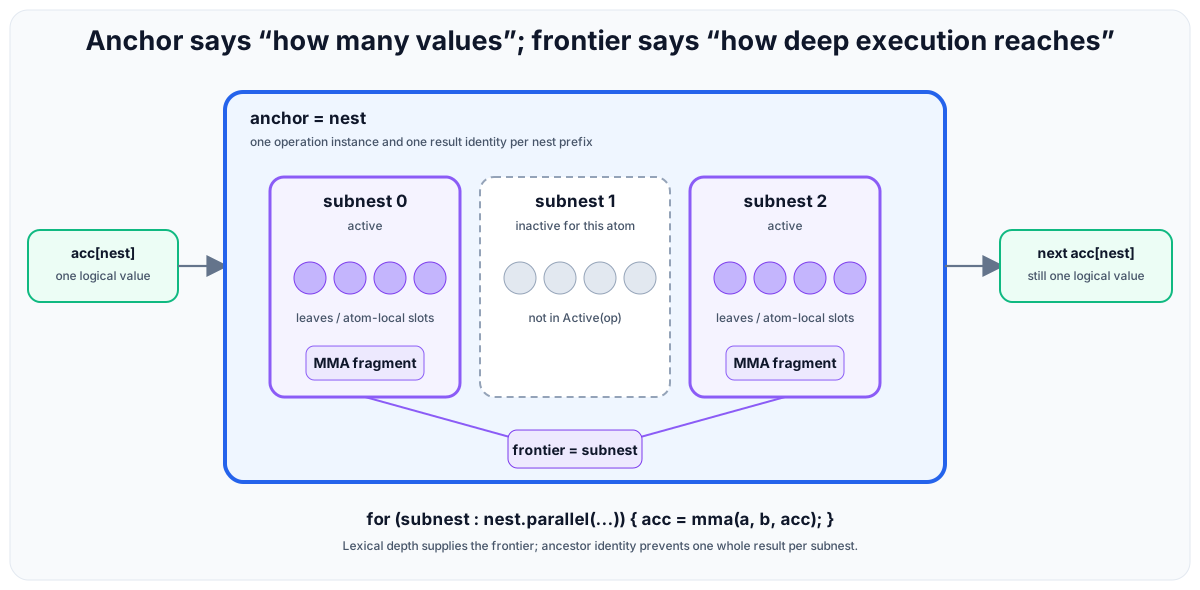
Anchor counts logical identities; frontier and Active(op) describe how those
identities are collectively realized.
The base DSL therefore needs no expression-level .at(level). Operation
placement is visible in lexical execution structure and value ownership. Atom
contracts and the target catalog may infer opaque local participants and slots
beneath the visible frontier; expert scheduling constraints can pin them
without contaminating the semantic expression syntax.
The frontier is a maximum hierarchy depth, not a claim that every coordinate
through that depth executes the operation. Active(op) is an IndexSet; its
default is the full Pb, while predicates, atom contracts, or a pipeline plan
may infer a subset such as copy producers and MMA consumers. This fact need not
appear as accessed_by(role) in ordinary C++. A role becomes a named execution
level only when it has stable logical coordinate, nesting, or ownership meaning;
a target-specific engine assignment remains a late scheduling choice.
Fine-grained SIMT-like code simply nests again:
for (auto &leaf : subnest.parallel(exec::infer)) {
    auto index = leaf.index();
    output(index).store(activation(input(index).load()));
}
This is a controlled descent into a sub-hierarchy, not the declaration of a new
memory scope. Ancestor-owned Tiles and memories remain readable and writable;
declaration scope is not a read-only boundary. Collective updates and
independent partial updates require the compiler to preserve the appropriate
result and completion semantics, not the user to adopt a special ancestor-write
API. An inconclusive conflict analysis does not itself invalidate a program
that uses the parallel contract.
These are model semantics. Current capture still rejects changed ancestor
values at a child parallel exit, and current TileIR/lowerers lack the general
result protocol. This is an implementation gap, not a language restriction;
see the implementation boundary.
Execution transform calculus
An execution transform is a typed reparameterization, not an opaque mutation
of a schedule. Let E be the old nest and E' the transformed nest. The pass
constructs:
tau : E' -> E
tau maps each active new execution coordinate to the logical coordinate whose
work it performs in the old program. A divisible split, fuse, coalesce, or
permutation is a bijection. A split with a tail uses an IndexSet predicate.
If a transform needs replication or another non-functional relation, it uses a
LayoutCorr and must separately prove the legality of duplicated effects.
Level boundaries carry semantics, so equality of flattened cardinality is not
enough. For every old prefix cut j referenced by an operation anchor,
frontier, memory owner, or convergence rule, a hierarchy-preserving transform
must find a new cut rho(j) and a prefix map tau_j such that:
tau_j : P'_{rho(j)} -> P_j

pi_j^d o tau = tau_j o pi'_{rho(j)}^{d'}
The equation says that selecting an old ancestor after remapping must depend only on the corresponding new ancestor, never on hidden descendants. If it does not factor, the pass may not silently cross that cut. It must reject the transform or explicitly re-anchor the operation, re-home the memory, and insert any required distribution or synchronization while proving equivalence.
Factorization is necessary but not always sufficient. A cut that defines
logical identity, such as a value anchor or memory owner, requires tau_j to
be bijective on its active prefix set. Otherwise several new prefixes could
claim the same old value or allocation (or one old identity could disappear).
Replication, merging, or re-homing is possible only as an explicit semantic
rewrite with its own proof.
For the common bijective case, every affected map is rewritten mechanically:
anchor'   = rho(anchor)
frontier' = rho(frontier)

Access' = Access o (tau_frontier x id)
beta'_{rho(j)} = beta_j o tau_j
Instance'_s = Instance_s o tau_owner(s)

Distribution'
  = (inverse(tau_anchor) x id)
      o Distribution
      o (tau_frontier x id)
The same rule applies to atom operands, view maps that mention execution axes,
and dependence coordinates. For guarded or relational transforms, TileIR uses
the corresponding IndexSet restriction or correspondence composition instead
of inventing an inverse.
The spatial transform basis is deliberately small:
splitandfuseuse mixed-radix maps;permuteuses an axis permutation, subject to prefix-cut preservation;reshapeandcoalescerequire a proved cardinality-preserving map;tileis derived from split plus permutation;insertion or removal of a unit level uses the identity isomorphism.
Serialization, vectorization, and machine-thread assignment do not rewrite the
logical hierarchy; they are choices inside ExecBinding. Pipelining does not
rewrite it either; it adds the temporal coordinate and issue policy described
in pipeline scheduling. Keeping these three operations distinct is what makes the system
execution-structure first without becoming hardware-structure first.
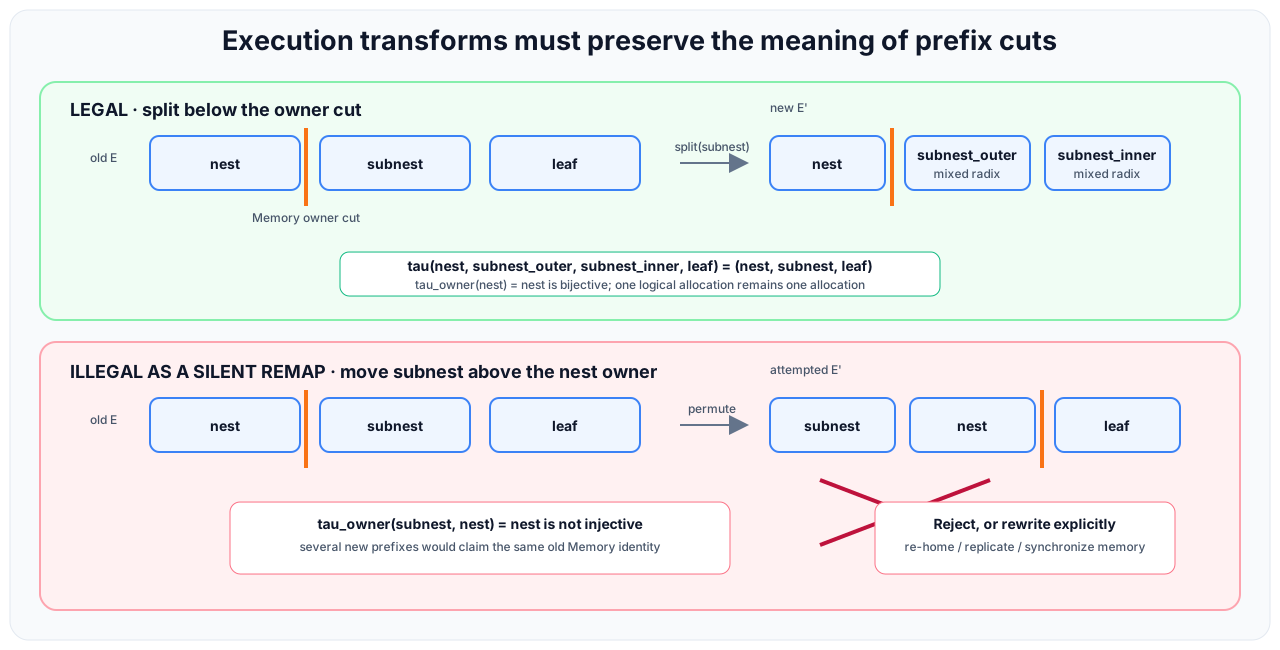
Transforms compose typed remaps and must preserve every semantically observed prefix cut.