Tile operations and reductions
These are language contracts and design extensions, not a promise of complete target support. Use the executable examples for current C++ spelling and implementation coverage for admitted lowering.
Storage and arithmetic precision
TensorView<T, Rank> and Tile<T> carry an exact element format. Changing T
does not create an execution Nest or choose a memory resource. The public
header luisa/tile/types.h exposes half (the existing luisa::half),
bfloat16 / bf16, float8_e4m3fn, and float8_e5m2, alongside the ordinary
fixed-width integer types. Include luisa/tile/runtime.h for typed Runtime
buffers and shader invocation.
C++ type |
Storage |
Numerical format |
|---|---|---|
|
2 bytes |
IEEE binary16, 5 exponent / 10 fraction bits |
|
2 bytes |
BF16, 8 exponent / 7 fraction bits |
|
1 byte |
Bias 7, finite values through ±448, signed zeros and NaNs, no infinities |
|
1 byte |
Bias 15, finite values through ±57344, signed zeros, infinities and NaNs |
|
1 byte |
Signed / unsigned integers; not implicitly scaled quantities |
The exact FP8 variant matters. E4M3FN, IEEE-style E4M3, and FNUZ are not
interchangeable. ScalarType::FLOAT8_E4M3FN is the TileIR name for the
finite-only format mapped to DLPack e4m3fn; there is no ambiguous
FLOAT8_E4M3 compatibility alias.
Storage, operation and accumulation precision are independent:
// A/B/C are TensorView<half, 2> arguments of an ordinary staged kernel.
auto acc = zeros<float>(shape(m, n));
auto a = A(coord(m0, k0), shape(m, k)).load();
auto b = B(coord(k0, n0), shape(k, n)).load();
acc = mma(a, b, acc);                         // FP16 inputs, FP32 accumulator
C(coord(m0, n0), shape(m, n)).store(cast<half>(acc));
A narrowing cast is a numerical event: cast<float>(cast<bf16>(x)) is not
x. Fusion, forwarding and temporary promotion must retain that rounding.
BF16 host conversion from float32 uses nearest, ties to even, preserves
signed zeros/subnormals, overflows to infinity and quiets NaNs. BF16 arithmetic
in the reference realizations uses FP32 and rounds its BF16 result explicitly.
Raw from_bits() / bits() and load/store copying preserve the encoded value;
they are not numeric conversion and preserve NaN payloads. Narrowing a wide
integer or FP64 value to BF16 currently requires an explicit intermediate
cast<float> on these bridges, rather than silently introducing double rounding.
tile::bitcast<uint32_t>(float_value) and tile::bitcast<float>(uint_value)
reinterpret the storage bits of a Scalar or Tile without numerical conversion.
They preserve the named axes and extents, including zero signs, subnormals and
NaN payloads. This initial API supports only the float32/uint32 pair; other
widths and index/view conversions are rejected. Native CUDA Tile, XIR and
TIRx lower this operation as a bit reinterpretation.
FP8 host wrappers expose exact bit storage and decoding to float32, but no implicit float-to-FP8 constructor. A future quantizing conversion must specify rounding and overflow/saturation independently of the format. Scale, zero point and per-channel/per-block scale tensors remain explicit values and indexing, not hidden fields of a layout or execution Nest. Packed INT4/FP4 likewise need an explicit packing/address map; an element must not be misrepresented as a byte merely because the Runtime is byte-addressable.
Current target boundary: FP16/BF16 and INT8/UINT8 mixed-precision examples
are exercised on XIR/SIMD and Metal/TIRx; native Metal MPP remains its existing
FP32 subset. XIR lowers FP16/BF16 MMA accumulators through FP32 internal
accumulation when MmaPolicy::allow_reassociation is enabled, then rounds the
result to the declared type. Strict BF16 accumulation still rejects, as does
BF16 accumulation on TIRx; BF16 inputs with an explicit FP32 accumulator are
supported on both bridges.
FP8 capture and typed Buffer allocation are available, but these
two Runtime routes reject FP8 execution explicitly. The XIR FP8 legalizer is
not implemented, and the pinned TIRx/Metal FP8 path is not qualified. Manual
Memory<half/bf16> works on Metal/TIRx; the XIR planner still rejects manual
Memory for all dtypes. See the migration and precision report.
LLVM’s layers should not be conflated: the checked local LLVM 21.1.8 has
half and bfloat IR types but no general FP8 IR scalar type; its APFloat
already represents multiple FP8 formats. Neither fact guarantees target
instruction support. TileIR therefore retains the format until the bridge
chooses a native atom, bit-storage legalization/conversion, or an explicit
unsupported diagnostic. See the LLVM type reference
and APFloat formats.
Elementwise operators lift directly to tiles
Pure scalar operators are rank-polymorphically lifted to Tile values. Common
arithmetic, comparison, selection, casts, and math functions therefore read as
ordinary expressions:
auto y = gelu(x + bias) + residual;
auto p = exp(scores - row_max);
auto finite = ite(mask, p, 0.0f);
ite(condition, true_value, false_value) means if-then-else, using the same name
and argument order as Luisa’s SIMT DSL. It supports Scalar and Tile values,
including broadcast conditions and operands. There is no Tile DSL select
alias: Luisa’s existing select(false_value, true_value, condition) uses a
different order. ite selects already-computed values; it is not lazy control
flow and does not by itself guard an unsafe load in either operand.
For scalar function f and named logical output coordinate q:
Elementwise_f(v0, ..., vn)[q]
  = f(v0[project_0(q)], ..., vn[project_n(q)])
The output dimension set is the compatible identity join of the operands. A
missing size-one dimension broadcasts; introducing or resolving any other
ambiguous dimension requires explicit broadcast, reshape, or reindex.
Diagnostic labels never participate in this decision. Physical
distribution is not part of elementwise semantics. If operand distributions
cannot feed one selected atom, scheduling inserts and costs a Repartition.
map(values..., scalar_lambda) remains the escape hatch for a custom pure
scalar expression, not mandatory ceremony around every elementwise operator.
Both forms become one elementwise op with a scalar SSA region in TileIR, so
fusion sees the complete expression DAG rather than an opaque C++ callback.
MMA is a portable value primitive
Matrix multiply-accumulate is the one tensor-shaped arithmetic operation in the Candidate core:
acc = mma(a, b, acc);
All three operands and the result are ordinary Tile SSA values. Shared logical
dimension identities determine the roles without a positional reduction-axis
argument. If the metavariables Batch, M, K, and N denote arbitrary
dimension products and
A : Batch x M x K
B : Batch x K x N
C : Batch x M x N
then mma(A, B, C) returns a value in Batch x M x N. Batch dimensions occur
in all three operands, contraction dimensions occur in A and B but not C,
and the two free dimension sets are checked against C. Unrelated argument
dimensions must first be related with with_dims or an explicit reindex; the
operation never guesses from labels, extents, strides, or physical layouts.
Its portable reference meaning is:
mma(A, B, C)[b, m, n]
  = accumulate_policy(C[b, m, n],
      { convert(A[b, m, k]) * convert(B[b, k, n]) | k in K })
The current typed operation records input/accumulator element types,
contraction dimensions, and MmaPolicy::allow_reassociation. Inputs are
converted to the accumulator type by the reference realization. MMA permits
reassociation by default, but does not permit silently reducing input precision
(for example, substituting TF32 for FP32). Ordered accumulation is explicit:
acc = mma(a, b, acc); // target may choose a compatible cooperative matrix atom
acc = mma(a, b, acc, {.allow_reassociation = false}); // preserve contraction order
The policy is stored on the TileIR operation and survives lowering; it is not just a frontend scheduling hint. Disabling reassociation retains the reference K order, not a promise to disable target FMA fusion or obtain bit-identical results on different devices. More detailed accuracy/rounding policies are design extensions, not implemented public options. A CPU may use vector FMAs; a GPU may select matrix atoms only when their numerical and layout contracts refine this operation. Otherwise the reference loop remains available.
The spelling deliberately includes C. mma(a, b, acc) is one fused update,
so acc += mma(a, b) would ambiguously add the accumulator twice. Common
matrix multiplication remains library sugar:
auto c = matmul(a, b); // equivalent to mma(a, b, zeros(result_shape))
The two-argument library overload uses the conventional
[..., M, K] x [..., K, N] interpretation. A general call either supplies the
local contraction Dim set or uses einsum; this convenience rule is not part
of the core mma semantics.
General einsum/contraction remains a library composition over reindex,
elementwise arithmetic, and reduce; scheduling may tile a compatible
expansion into mma. There is still no GEMM, convolution, or attention opcode.
The semantic mma op preserves cross-target arithmetic and layout-legality
information; a target MMA atom specifies concrete participants, operand slots,
instruction shapes, and resource protocol.
Reduction is a structured algebraic region
Current surface versus proposed contract. Nest::reduce(IndexSpace, policy)
and ordinary carried assignment are implemented. The default is
reduction::unordered_tree; each REDUCE operation stores a typed
ReductionPolicy. TIRx and XIR preserve explicit order restrictions, and backend
switches control candidate availability only. Custom lift/merge contracts,
their general validation and the richer domain conveniences below remain design
extensions. Unrecognized bodies currently retain a serial realization; they
are not silently granted an invented parallel merge.
A reduction uses the same invariant as every other range-for construct: the loop variable is the current region scope, never a data value or accumulator proxy:
auto columns = x.dim<1>();
auto sum = zeros<f32>(x.shape().without(columns));

for (auto &column : nest.reduce(x.domain(columns))) {
    sum += x.at(column);
}

use(sum); // the outer Tile identity now denotes the reduced result
column is a non-copyable Nest handle, just like the other range-for bindings.
Its index identifies a contribution coordinate, not a memory element or worker.
The domain/coord conveniences in this schematic surface do not prescribe
hardware binding.
x.domain(columns) is a typed IndexSet; x.at(column) is a pure Tile
projection implemented by reindexing. Neither operation chooses participants,
memory, or a collective.
The proposed region signature is deliberately source-free and state-free:
nest.reduce(domain, contract?, policy?)

domain      typed semantic contribution coordinates
contract    optional lift/merge/type/law contract for tree realization
policy      reference fold and permitted regrouping, never a warp count
The body is captured once. On region close, the frontend finds every Tile
defined outside the region and updated inside it. Those values become the
region’s incoming block arguments and outgoing results. Locals remain locals;
stores and atomics remain effects; neither can accidentally become a reduction
state. There is no public result(), yield, accumulator proxy, or state list.
In the proposed analysis, the update graph supplies information that an
explicit accumulator list would duplicate. A
canonical state += contribution, state = maximum(state, contribution), or
corresponding minimum/logical form identifies a possible reducer contract.
state = mma(a, b, state) still has its own inner contraction policy; recognizing
this update does not authorize reordering the outer block/tap fold. A tree
candidate needs a compatible lift/merge and numerical contract for that fold.
Independent states may form a product reducer with permissions checked for each
component; coupled updates need a joint contract. Recognition of floating-point addition
does not by itself permit arbitrary reassociation; the math policy still decides
that. A custom contract can be supplied after the domain:
auto stats = scalar(WelfordState<f32>::identity());
for (auto &feature :
     nest.reduce(range(0, features), welford)) {
    auto value = X[coord(row, feature.index())];
    stats = welford_push(stats, value);
}
An unrecognized pure update can use an explicitly selected strict fold.
The default tree policy still needs a compatible merge contract; if none is
available, diagnose the missing contract and suggest a fold policy rather than
silently inventing a merge. Programs with observable intermediate states or
general ordered effects use serial or a suitable scan/effect contract.
An external view may use the scope as an input to its ordinary view map, which supports the spelling proposed for tiled streaming reductions:
auto acc = zeros<f32>(output_shape);
for (auto &elem_nest : nest.reduce(reduction_tiles)) {
    auto x = X.tile(elem_nest, x_tile_map, bounds::zero).load();
    acc += reduce(x, x.dim<1>(), add);
}
Here x_tile_map : ParentCoord x ReductionCoord x LocalCoord -> XCoord is a
normal typed ViewMap. elem_nest contributes coordinates, not a memory level
or address. Writing the origin explicitly with elem_nest.index() is exactly
equivalent.
Common pure cases keep a short expression form:
auto columns = x.dim<1>();
auto sum = reduce(x, columns, add);
auto max = reduce(x, columns, maximum);
These are library shorthand for a reduction region with a generated domain,
state, and update. The reducer argument remains here because there is no body
from which to infer it. In the region form, sum was merely the user’s outer
Tile variable and add was the merge-law contract; neither belongs in the
range binding or needs to be repeated when the update graph is canonical.
After frontend variable promotion, the region has ordinary SSA plumbing rather than a serialized reducer opcode:
%sum1 = reduce.region domain(%columns)
          init(%sum0) reducer(@add) {
  ^update(%state, %reduction_coord):
    %elem = tile.project %x at %reduction_coord
    %next = add %state, %elem
    yield %next
}
The state, coordinate, contribution-producing operations, grouping projection, and body are independently inspectable and rewritable. A pass can fuse a producer, split the reduction domain, change its placement, or replace the body with a target atom without losing the original reducer contract.
Reference fold and permitted regrouping
The following presets are implemented C++ API. They extend the existing
reduce primitive rather than introducing four kinds of nest.
For the source contribution sequence x0, x1, x2 and incoming state z:
Policy |
Reference / permission |
Required contract |
|---|---|---|
|
Regroup and permute contributions; seed exactly once |
Compatible lift/merge |
|
Regroup; preserve leaf order and the seed’s reference position |
Compatible lift/merge |
|
|
No merge law required; preserve this update chain |
|
|
No merge law required; preserve this update chain and operand orientation |
The source default is unordered_tree. Ordinary nest.reduce(domain)
authorizes a compatible reducer’s tree regrouping and contribution permutation,
including changed FP32-add rounding; users need not add a fast-math switch to
obtain that permission. ordered_tree, fold_left and fold_right are explicit
restrictions. A tree policy permits a serial realization too: it describes a
set of allowed computations, not a mandatory hardware algorithm.
This default does not authorize a different accumulation dtype, approximate
transcendentals, FMA contraction or ignoring NaNs; those remain independent
arithmetic contracts. A strict floating-point operation mode does not retract
the reduction’s regrouping permission. Conversely, an explicit fold restriction
must survive every backend and tuning configuration. Current striped Metal
collectives and CPU array reductions require unordered_tree; ordered trees
conservatively retain a source-ordered recurrence. XIR/SIMD currently retains
serial reductions for all four policies. The Metal and SIMD Runtime factories
disable kernel-wide fast-math when any reduction requires order, because their
current final compiler interfaces cannot express a local arithmetic override.
This does not turn unrelated unordered reductions into explicit folds.
The TIRx LLVM target likewise cannot override order with global fast-math
flags. TVM’s own Metal runtime requires the optional precise-math extension;
without it, ordered reductions fail compilation explicitly. Luisa’s Metal
Runtime uses its own compiler options and needs no such TVM extension.
For order-sensitive policies, multidimensional source order is lexicographic
in the IndexSpace axis order over active coordinates; physical layout, lane
number and storage replication cannot redefine it. A policy is not an
optimization-strength integer: left and right folds generally compute different
functions. Mathematical laws and policy-granted relaxation are distinct
evidence. FP32 addition does not have exact associativity.
The ordinary assignment spelling remains visible in both directions:
// x is an existing Tile over the axis k.
auto left = Scalar<float>{0.0f};
for (auto &r : nest.reduce(shape(k), reduction::fold_left)) {
    left = left - x.at(r);
}
auto right = Scalar<float>{0.0f};
for (auto &r : nest.reduce(shape(k), reduction::fold_right)) {
    right = x.at(r) - right;
}
Right fold visits contributions in reverse source order and uses the stated
element/state operand orientation. The policy does not silently change
state - element into element - state; doing only a reversed left-fold
traversal is not the same contract. For x = [1, 2, 3] these examples yield
left = -6, right = 2. Heterogeneous folds must type-check the appropriate
State x Elem -> State or Elem x State -> State update.
Grouping, merge legality and edge cases
Formally the region declares a reduction coordinate space R. Each inferred
state has a result coordinate space G and a set of semantic contribution
occurrences Omega, with iteration : Omega -> R and
group : Omega -> G. For x.domain(axes), group is the familiar projection
that removes those axes. For a general map-reduce body it is inferred from the
shape/index map of the state update. Each grouping fiber has an ordered list
omega0, ..., omegaN-1. A strict fold only requires a typed update and seed;
it does not require an identity or a parallel merge. For a tree-enabled
left-reference reducer with a lawful monoid (S, identity, merge) and
contribution lift(omega), one admitted realization is:
result[g] = merge(incoming[g],
                  ordered_merge(identity,
                                [lift(omega0), ..., lift(omegaN-1)]))
For a domain occurrence omega, the captured body computes
update(state, omega) using arbitrary pure contribution-producing operations.
For an exact ordered-tree rewrite, sufficient laws are:
update(s, omega) = merge(s, lift(omega))
merge(merge(a, b), c) = merge(a, merge(b, c))
merge(identity, a) = a = merge(a, identity)
Without exact laws, the tree policy must admit the changed results for that compatible reducer. This is how the default FP32 sum allows tree rounding without falsely asserting exact associativity. A law declaration and numerical permission remain separate evidence, even when they enable the same candidate.
For a right-reference update, the lift/merge relation instead has the element
on the left: update(omega, s) = merge(lift(omega), s), with the seed at the
right boundary. A generic State x Elem -> State update does not automatically
provide State x State -> State merge.
The fiber is an ordered contribution sequence unless the contract also grants
permutation. Associativity permits different parentheses, not an arbitrary
permutation: preserving a noncommutative reducer’s source sequence requires
contiguous partial sequences and an order-preserving merge. Striped worker
assignment generally changes order
and needs the stronger permission. For example, combining [a,c] and [b,d]
as (a op c) op (b op d) reorders leaves. An independent output-group direction
and a reduction direction are separate factors of one domain, as formalized in the
execution calculus.
The intended library catalog supplies conditional contracts for built-in updates and custom states such as Welford. The current implementation is narrower; body recognition is not a proof of arbitrary custom laws. Strict folds remain valid without merge laws. Floating-point reassociation, precision, FMA behavior and determinism are separate policy dimensions. A fixed tree can be reproducible within one configuration without being bit-identical across different JIT configurations or devices.
The contract must also define:
Seed versus identity: incoming state is included once, in its specified position; it is not copied into every worker’s partial. Empty fibers return that seed. Masked-out occurrences are skipped; padded physical lanes may use an identity only when it is valid under the selected arithmetic semantics, otherwise partials carry validity.
Exceptional values: overflow, NaNs, signed zero, ties and argmax ordering are part of the operation contract, not guessed from an intrinsic name.
Local permissions: the language/kernel default resolves at capture; a stricter local policy is never widened by a backend or tuner. Independent state components may need separate trees or a common stricter realization.
Proof boundary: builtin facts, derived conditions and trusted custom law declarations retain their provenance. Random testing can falsify a law, not prove it for an arbitrary function.
Storage replicas are not semantic contributions. A domain generated by the
expression-reduce library contains each logical Tile element once even if its
LayoutCorr has several physical occurrences. An explicit region domain
likewise creates one semantic contribution per domain coordinate on purpose.
This distinction prevents a broadcast or replicated fragment from silently
multiplying a sum.
reduce introduces a lexical reduction domain R, not a resource-owning
spatial prefix. Scheduling factors it with ordinary layout maps:
ReductionPlacement : R -> ParticipantFiber x LocalSerialStep
MergePlan          : PartialStateOccurrences -> ResultStateOccurrences
With the corresponding permission and merge contract, it may become a lane shuffle tree, a shared-memory tree, a SIMD horizontal operation or a hybrid. A strict fold preserves its chain while independent output fibers may still execute in parallel. The remaining logical axes determine the result shape; their distribution may stay sharded or acquire explicit replica fibers.
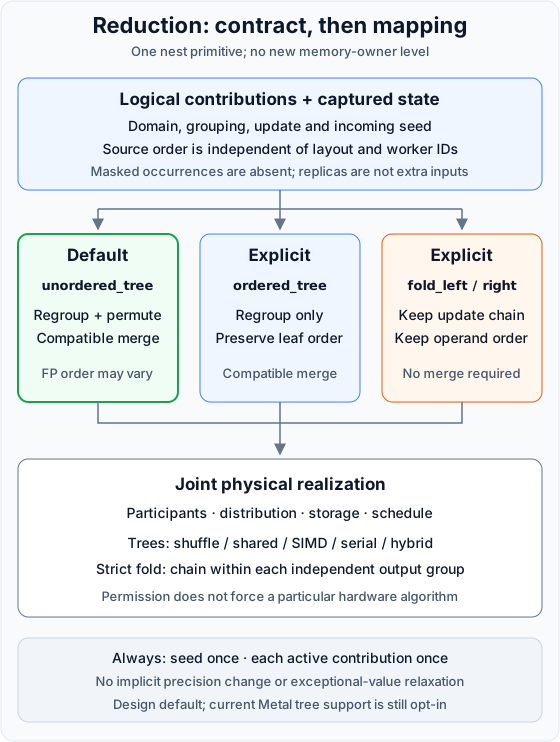
Grouping and the selected fold/tree contract define meaning. A compatible merge and the permitted transformations open distribution and collective choices; missing merge laws do not invalidate an explicitly selected strict fold.
The first proof-driven realization of this factoring is now implemented for
Metal FP32 add/max/min row programs. It maps a logical reduction to one or more
SIMD groups and derives worker-private/shared storage from the selected owner
map; see the generated SIMD-group intrinsic path. In that bounded
implementation, metal_subgroup_reductions only enables the candidate family;
the per-operation policy supplies tree-order permission. The Metal Runtime
enables this family automatically when it owns capability/noalias validation
and the caller has not supplied an explicit TIRx configuration. Standalone
TIRx compilation still requires those target contracts. A richer per-reducer accuracy,
determinism, NaN and signed-zero policy remains part of this language design,
not a feature already exposed by the current C++ surface.
The same execution/resource separation is observable for an indirect gather.
A distributed definition of logical Tile[N] does not make the other
elements of each worker’s physical private array valid. The current Metal
realization either forwards a guarded immutable Tensor view or proves every
remaining local access has the current worker owner; otherwise it falls back.
This is a backend proof over the general gather operation, not a new
loss-specific primitive or source memory level.
A custom state reduction remains compact. Welford normalization, for example, uses one state instead of hard-coding a two-pass warp algorithm:
auto feature = x.dim<1>();
auto stats = full<WelfordState<f32>>(row_shape, welford_identity);
for (auto &item : nest.reduce(x.domain(feature), welford)) {
    stats = welford_push(stats, x.at(item));
}
auto y = (x - stats.mean) * rsqrt(stats.variance() + epsilon);
An ordinary tile_kernel still cannot assume a device-wide barrier between
independent root instances. A whole-tensor loss either chooses a proved
single-dispatch realization (for example a supported cooperative collective or
an explicitly permitted atomic result), writes per-root partials and launches a
second reduction kernel, or lives in a future multi-dispatch tile_program.
The frontend never disguises an illegal global synchronization as a Tile op.
Scan preserves prefixes, not a new execution hierarchy
Design direction, no new core primitive required (September 9, 2026). Keep
scan as a Tile-level library operation, not another range-for Nest. A chain
of logical reindex/gather and elementwise operations already expresses prefix
scan. The current migrated examples use exactly such a blocked Hillis–Steele
composition; they do not use a SCAN opcode or a cooperative scan planner.
Their slow realization is evidence of a communication/mapping gap, not proof
that the core language lacks expressive power. A public scan convenience
can reuse the reducer’s identity, combine function, accumulator type and
numerical contract without requiring a new primitive.
The proposed simple surface is:
auto x = A.tile(origin, shape(rows, columns), bounds::zero).load();
auto prefix = scan(x, columns, add); // proposed library helper: inclusive, ordered tree
Y.tile(origin, shape(rows, columns)).store(prefix);
columns is an ordinary user-defined Axis, not a predefined semantic or
hardware axis. An options argument can request exclusive output, an explicit
seed, or a strict left fold; it does not specify a warp width. The first
implementation should support existing builtin reducers before introducing
custom tuple-state combine regions. Spelling of those options is not yet part
of the implemented C++ API. The underlying composition is already expressible:
auto prefix = x;
for (int64_t distance = 1; distance < width; distance *= 2) { // host staging
    auto left = gather(prefix, iota(columns) - distance, columns, 0.0f);
    prefix = left + prefix;
}
Here width is the staged column extent. gather supplies a logical shift
with defined boundary fill; a bare out-of-bounds reindex would not. Each
iteration reads the previous SSA Tile, so updates are simultaneous rather than
an in-place sequential sweep. For length n, this direct Hillis–Steele chain
has O(n log n) work and O(log n) depth. Work-efficient up/down-sweep and
hierarchical segmented algorithms are alternative library compositions. In the
current bounded example, fixed-width chunks bound the chain size and a serial
carry joins chunks; that bounds temporary size but does not select a profitable
worker layout.
Why not just infer it from reduce?
A serial carried assignment followed by a store can express a prefix scan.
However, a final-state reduction and an observable sequence of intermediate
states grant different transformations. For an ordered fiber x[0..n) with
seed z and combine operation op:
left prefix[0] = z
left prefix[i + 1] = op(left prefix[i], x[i])
inclusive[i] = left prefix[i + 1]
exclusive[i] = left prefix[i]
reduce result = left prefix[n]
An ordered-tree scan may regroup each prefix when the merge/math contract
permits it, but must preserve that prefix’s leaf sequence and include the seed
once. The existing default reduce policy remains unordered tree. Moving
[1, 2, 3] to [3, 1, 2] preserves an integer sum of 6, but changes inclusive
prefixes from [1, 3, 6] to [3, 4, 6]. Therefore scan must not inherit the
permission to globally permute reduction contributions. Associativity permits
parallel prefix evaluation; commutativity is not required. A noncommutative
combine must receive the earlier subsequence on its left. Floating-point
regrouping permission does not imply exact real associativity or relax dtype,
NaN, signed-zero or rounding rules.
The current closed-reduction fast path recognizes a final scalar carry with restricted pure updates; stores of intermediate carries do not qualify. Reconstructing all prefixes from arbitrary effects would require additional alias, observation and dependence analysis. The pure reindex-chain composition avoids that issue without a SCAN opcode. First improve preservation and optimization of those logical read relations for all operations. If expanding early demonstrably prevents useful algorithm selection or causes excessive IR growth, retain a typed, decomposable scan library operation until planning. That is an optional compiler representation choice, not an additional source execution primitive or an opaque function-name-based optimization rule.
A hand-written chain specifies a particular arithmetic graph. Replacing it with a different scan tree requires the corresponding numerical permissions; recognizing shifted indices alone does not authorize reassociation. A library scan may declare the ordered-tree contract and expose several equivalent decompositions for JIT/planner selection. Keep that contract and its provenance with the computation if needed; do not infer arbitrary custom associativity from the body or erase intermediate low-precision rounding.
Empty input produces an empty output; a separate final-state result, if added,
would be the seed. Masked contributions are skipped under a defined mask
contract, rather than treating every padding value as a valid identity. A
strict fold preserves the recurrence above. Reversing the axis is expressible
by reindexing, and segmented scans can use a lifted (head, value) associative
state; neither needs a new Nest kind. A serial reference expansion can perform
linear work. The parallel library algorithm need not independently reduce all
n prefixes in quadratic work.
What the old implementation and other systems teach us
The pinned legacy tile_to_kernel.cpp at commit
ccdfcbebef7fa95431c988e1fcbdd87ffdce9fdc has a dedicated _emit_scan for
CUMSUM/CUMMAX. Its actual code uses unconditional, clamped
WARP_READ_LANE exchanges followed by guarded combines. One warp handles a
scan line in chunks and carries each chunk’s total into the next. When there
are too few lines, a separate multi-warp path computes segment totals,
communicates prefixes through shared memory, then recomputes the segments with
their incoming carry. The old source warns about a prefix-sum intrinsic in
nested control flow; that historical comment is not a newly reproduced backend
defect. The implementation’s hard-coded 32-lane block heuristic, sum/max-only
combine ordering, and fragment staging are not general reducer contracts to
copy into the new frontend.
System |
Relevant separation |
Lesson for this design |
|---|---|---|
Generic combine, distinct pure scan operation, same logical result shape |
Preserve prefix semantics and custom state in IR without adding an execution region; no MLIR dependency is implied |
|
|
Borrow collective lowering techniques; do not make physical warp operations mandatory in portable Tile code |
|
Inclusive Tile scan with combine, identity and tuple state |
A value builtin can remain generic and composable |
|
Thread, Warp, Block and Device algorithm layers |
Keep hierarchy-specific algorithms and their workspace costs behind target capabilities |
These are existing precedents, not evidence that scan or execution/memory separation is novel. Their builtins demonstrate a useful representation option, not a requirement to copy their primitive sets. Our design choice is to solve the composition’s placement within the existing execution/resource mapping rather than bake one physical hierarchy into the source operation.
The new legacy comparison exposes a real
gap: current scans retain worker-private arrays and nested loops where the old
path uses lane exchange. Ordinary Metal sum reductions already emit simd_sum;
that does not mean scans benefit from the same machinery. Preserving scan
semantics can aid algorithm selection, but fixing general logical exchange is
the first priority; an added opcode would not itself implement that mapping.
Logical exchange versus physical shuffle
Keep the public portable vocabulary small: reindex for coordinate maps and
gather for single-axis index-Tile selection with fallback from an SSA Tile. Today both are library
compositions over map and Tile extraction, not dedicated exchange primitives.
They are expressive enough to describe logical permutation and selection, but
their current scalarized representation does not guarantee efficient
cross-worker communication.
These are overlapping interfaces, not a static/dynamic partition. Current
reindex(x, output_space, f) accepts runtime Scalar coordinates and means
y[j] = x[f(j)]; f need not be affine, injective or surjective. It can express
permutation, repetition/broadcast and sub-selection. gather supplies one axis
of f from an index Tile, combines the source’s remaining dimensions with the
index Tile’s dimensions by identity, and defines fallback for invalid indices
on that axis. A general masked/filling pullback can cover both, but the current
bare reindex API has no portable out-of-bounds fill contract.
For valid domains and the same SSA snapshot, pure chains compose as
R_g(R_f(x)) = R_(f composed with g)(x). Masks and fallback values must be
composed too; intervening arithmetic is not another coordinate rename.
Scatter is the opposite relation: each source i targets g(i). A unique
destination write may use explicit MemoryRef/ElementRef.store; collisions
need an explicit reducer or execution order. Independence is already the
source parallel contract, not permission to reinterpret conflicting stores
as addition or last-writer-wins. There is currently no public scatter helper
or Tile atomic opcode. A future value-producing scatter can be a library
composition of target-fiber grouping and reduction; an effectful scatter must
retain its store effects. Only under bijective coverage and matching bounds
and effect conditions is it simply inverse reindexing.
Logical operation |
Coordinate relation along one axis |
Possible library spelling |
|---|---|---|
Axis permutation / transpose |
Permute coordinate components |
|
Shift with defined boundary fill |
|
|
Butterfly partner |
|
|
Broadcast one element |
Constant source coordinate |
Projection and broadcast |
Dynamic selection |
Source coordinate comes from an index Tile |
|
The right column describes existing operations or optional library helpers, not a new implemented API set. In particular, a logical butterfly is not necessarily a physical lane XOR: blocked layouts may put partners in different registers, lanes or subgroups. Axis permutation can even cost no data movement when the output ownership is free to change. Triton’s transpose encoding discussion illustrates this distinction: logical coordinate renaming and physical layout conversion are separate decisions.
For a logical read relation source = f(destination), let S(q) be the set of
physical occurrences providing source element q, and D(j) the selected
occurrence consuming destination element j. The communication plan selects
a valid provider in S(f(j)) for each consumer. These relations include the
ancestor execution coordinates, local register/storage coordinates, validity
and availability time; a replicated value does not require a unique inverse
layout map. Depending on the selected providers, the plan can be a register
rename/local read, SIMD permutation, subgroup shuffle, shared-memory exchange
with synchronization, or an explicit inter-program communication phase.
The planner must jointly price source/output ownership, communication and
consumers, rather than assuming every reindex is free or every gather needs
shared memory. Candidate costs include work and critical-path depth, live
state/register pressure, shuffle traffic, shared bytes/bank conflicts,
barriers, occupancy and global memory traffic. Backend policies supply measured
capabilities/costs; the solver chooses among legal candidates. For scan this
includes contiguous local segments, subgroup prefixes, block-level carry
exchange and possible recomputation versus retained local prefixes. The
baseline algorithm and its work bound remain available when a target lacks a
specialized collective.
Do not add mandatory shuffle_up/down/xor calls to generic Tile kernels now.
First preserve or canonicalize the logical read relation and teach the
bridges to lower it using the selected owner map. A future explicitly bound
SIMT escape hatch may expose physical lane intrinsics with convergence,
participation-mask, width and capability constraints; it must not silently
restrict the remapping freedom of ordinary Tile code. That extension is
separate from the current standalone Tile-kernel work. Ballot/bit packing is
also a different semantic operation, not an excuse to collect unrelated warp
intrinsics under a generic shuffle primitive.
Validation should cover noncommutative associative combines, seeds, inclusive/exclusive boundaries, empty/single/ragged axes, non-power-of-two lengths, subgroup/block boundaries, strict floating-point folds, exceptional values and low-precision accumulator conversion. A device-wide scan still needs an explicit supported multi-dispatch/synchronization plan; no independent root instance acquires an implicit global barrier.
Ordering and selection stay logical Tile operations
Full sorting is not forced into the reduction abstraction. The Tile library
defines sort as a logical permutation along named axes with a pure total-order
contract:
auto feature = x.dim<1>();
auto sorted = sort(x,
                   feature,
                   descending,
                   stable_ties(),
                   nan::last);
It returns values and, when requested, the logical source permutation. Its reference expansion uses core comparison/ite, reindex, reduction, and structured regions; no core SortOp is required. The meaning does not mention a sorting network, radix digit, lane exchange, shared memory, or merge pass. Distribution analysis may keep the axis local, repartition it, or reject a requested single-kernel schedule that cannot communicate across the required participant scope. A target may replace a proved equivalent expansion with a sort atom.
The current C++ API is sort(x, feature, largest) and
topk(x, feature, count, largest), returning RankedTile<T> with values and
INT64 source indices. It requires non-NaN inputs and breaks equal-value ties by
original index, including ties between the two zero signs. An explicit final
SortAlgorithm::PACKED_FP32 argument selects a reversible UINT64-key network
for float32 and power-of-two extents up to 2^31. The key carries the original
index and zero sign, so decoding recovers the original value bits without a
second input gather. Other inputs reject this option; the default algorithm
is unchanged. The richer ordering-policy example above describes the intended
interface, rather than additional implemented overloads.
Fixed-size Top-K does have a useful reduction algebra. For a deterministic
total key (valid, value, original_index), define:
State_K             = sorted sequence of at most K candidates
merge_K(a, b)       = take_K(sort(a union b))
identity_K          = empty sequence

merge_K(merge_K(a, b), c) = merge_K(a, merge_K(b, c))
Discarding everything below the current K-th candidate cannot affect any later
Top-K merge, so this is associative under the stated total order. The general
region form is therefore ordinary reduce over an indexed Tile:
auto best = topk_identity<f32, K>(descending,
                                  tie::lowest_index,
                                  nan::last);
for (auto &feature : nest.reduce(
         x.domain(x.dim<1>()),
         topk_merge<K>)) {
    auto item = indexed_value(x.at(feature), feature.index());
    best = topk_insert<K>(best, item);
}
topk<K>(x, axis, order...) is a library shorthand for that region, not a
second execution model or primitive. K is normally an ordinary host/JIT
specialization because it changes the result type and Tile shape. A runtime k
uses a statically bounded KMax result plus a staged valid count; it never
creates a dynamically sized register fragment.
A large full sort is a launch graph: block-local sort, followed by
merge_sorted passes, or radix histogram + scan + scatter passes. Those
pieces are ordinary Tile operations nested in parallel, serial, and
pipeline; global pass boundaries remain explicit for the same reason as a
whole-tensor reduction.