TileIR → XIR: execution planning and backend realization
Status: CPU realization with bounded packet-index proofs and compiler-owned snapshots, bounded Tile traversal, closed unordered partials and an opt-in packet-local mapping; backend-provided execution target info and a Metal4 XIR/AIR Runtime adapter, September 14, 2026. The finite solver below is implemented. General Tile distribution, packed matrix atoms, software pipelining and measured cost calibration are not. Shared static snapshot analysis and backend-owned pre-cost resource admission are implemented and regression-tested. Their verification is recorded separately from older benchmarks; they do not imply measured cost calibration or a kernel speedup.
This document complements the language/layout design, target-independent planner formulation and Runtime integration. It does not redefine the DSL for the CPU backend.
1. Preserve the execution-first program
The frontend declares which independent programs and ordered computations exist, not a fixed CPU vector width or GPU block arrangement. For example:
auto definition = tile_kernel("gemm", [=](TensorView<const float, 2> A,
                                         TensorView<const float, 2> B,
                                         TensorView<float, 2> C) {
    auto gm = axis("gm", ceil_div(M, BM));
    auto gn = axis("gn", ceil_div(N, BN));
    auto m = axis("m", BM), n = axis("n", BN), k = axis("k", BK);
    for (auto &nest : parallel(shape(gm, gn))) {
        auto m0 = nest.index(gm) * BM, n0 = nest.index(gn) * BN;
        auto acc = zeros<float>(shape(m, n));
        for (auto &step : nest.pipeline(shape(ceil_div(K, BK)),
                                        {.window = 2, .interval = 1})) {
            step.stage("load");
            auto k0 = step.index() * BK;
            auto a = A.tile(coord(m0, k0), shape(m, k)).load();
            auto b = B.tile(coord(k0, n0), shape(k, n)).load();
            step.stage("compute");
            acc = mma(a, b, acc);
        }
        C(coord(m0, n0), shape(m, n)).store(acc);
    }
});
The loop variables are Nests, loads produce Tile SSA, assignment captures
loop-carried dataflow, and stores are explicit effects. No CPU-only lane,
mma_team, memory-owner annotations or builder-qualified math leaks into the
program. Several independent resources may be used by the same Nest.
2. Module and ownership boundaries
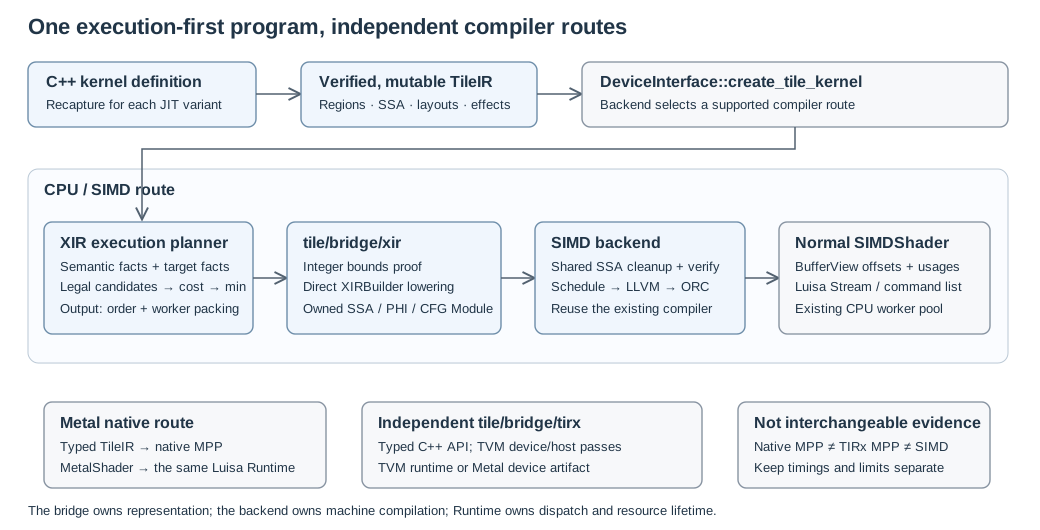
Planner, bridge, backend and Runtime are separate owners. No Python source or AST reconstruction is inserted between TileIR and XIR.
Component |
Owns |
Does not own |
|---|---|---|
TileIR |
Typed semantic operations, nested regions, mutable use-def structure |
LLVM, TVM, device queues |
XIR planner |
Semantic admission, finite candidate enumeration, work extraction |
CPU/GPU hardware constants, Runtime allocation or JIT |
Backend target info |
Candidate widths, extra legality, scheduling and default cost policy |
Relaxing TileIR semantics |
XIR lowerer |
An owned XIR Module and typed argument/dispatch metadata |
AST reconstruction or serialization |
SIMD backend |
Schedule/LLVM compilation, native shader and CPU dispatch |
A second Tile language |
Metal4 backend |
XIR/LLVM/AIR compilation, PSO ABI checks and GPU dispatch |
CPU home-chunk scheduling or MSL export |
Runtime adapter |
Shader lifetime, argument/range checking, normal dispatch commands |
Hardware scheduling policy |
Public headers live in include/luisa/tile/bridge/xir/; implementations live
in src/tile/bridge/xir/. The bridge links TileIR and XIR, not TVM, LLVM,
SIMD or Runtime. Native MPP lowering remains in the metal backend; the
metal4 backend consumes the same XIR result directly through its AIR path.
The input Module is borrowed and unchanged. The lowerer returns an owning Module, not a dangling function pointer. Passes may rewrite its basic blocks, PHIs, use lists and instructions; this is deliberately not a wire format. The SIMD adapter runs the existing shared SSA optimization factory, then CFG simplification and reachable-block verification. It does not rerun AST destructuring or inlining on already plain SSA. Diagnostic LLVM capture is independent of assembly capture, so normal compilation does not perform a second machine-code compilation merely to retain source identity.
3. Formal mapping: ancestry plus local access
Let the root independent domain be a finite box
D = [0,d0) × ... × [0,dr−1). A candidate permutation π is ordered from
outermost to innermost execution axis. Define:
jπ(c) = Σt c[π(t)] × Πu>t d[π(u)]
c = unflattenπ(j),  0 ≤ j < P,  P = Πi di

block   = floor(j / B)
packet  = floor((j mod B) / W)
lane    = j mod W                 (B is divisible by W)
B is the logical workers per Runtime block; W is the backend’s packet
width. Incomplete final packets are masked by the existing SIMD ABI. The
worker pool assigns blocks dynamically; a block is not pinned to a specific
OS thread. The permutation is a bijection of the existing parallel
instances. It does not require proving the independence already promised by
parallel, and it does not create new independent instances.
For a local Tile coordinate e, lexical descendant coordinates s and a
view origin o, the logical access is:
ancestor coordinates c, descendant coordinates s, local Tile coordinate e
                        │
                        ▼
            logical buffer coordinate v = o(c, s) + e
                        │
                        ▼
      compact row-major element address = Σi v[i] × stride[i]
                        │
                        ▼
             bound BufferView byte offset + sizeof(T) × address
The execution map changes j ↔ c, not the buffer strides. Each buffer may
have a different origin, logical shape and access relation at the same scope.
This is the concrete subset of the general typed composition
AddressMap ∘ ViewMap ∘ LocalAccess ∘ AncestorProjection.
The current exporter materializes compact static buffer indexing only. The language’s richer layout algebra and proof system are not all realizable by this exporter yet. Representability in TileIR must not be confused with backend support. Unknown layouts/bindings fail closed.
Before creating bounds diamonds, the exporter derives integer intervals from actual Nest coordinates and supported signed-i64 expressions. Checked add/subtract/multiply and positive constant division/modulo may prove an axis access in bounds. Negative offsets, unknown expressions and any possible signed overflow keep the guard. This proof is separate from the cost model’s floating-point address-slope estimate. It neither asserts noalias nor moves a load across an effect. LLVM simplification alone is too late to prevent unnecessary per-element branches from inflating the earlier SIMD Schedule.
Indexable snapshots preserve Tile value semantics
A Tile is still an immutable SSA value, not a deferred buffer view. The XIR lowerer distinguishes access forms without changing the DSL:
A constant coordinate, including an expanded Tile-map coordinate and supported checked integer expressions, directly selects the scalar SSA element. It does not build a full SELECT chain for LLVM to simplify later.
A Tile with runtime-indexed extract users receives a compiler-owned local array at its definition. The lowerer stores its elements once, then emits a guarded GEP/load at each dynamic extract. Singleton/empty values and unproved statically expanded expressions retain the SSA fallback.
buffer.load at definition
          │
          ▼
       Tile SSA
          │ save once
          ▼
   private snapshot[D]
          │ guarded indexed read
          ▼
    extract(index(r))

Later buffer.store changes the
buffer, not this snapshot.
For D input elements and R runtime extracts, the selected representation
replaces D×R selection work with D definition-time stores plus R indexed
reads. The eager baseline stores at definition; the admitted first-consumer
fusion below may instead initialize the snapshot during its first traversal.
Small loop carries use simultaneous PHIs; the bounded large-carry representation
below uses a staged parallel copy and preserves zero-trip initial state.
Distinct SSA definitions have distinct storage, preserving multi-Tile swaps.
An input parameter being const is not a noalias assertion: an overlapping
writable argument may overwrite the buffer without changing the snapshot.
This is a physical representation repair, not contribution-axis vectorization.
The SIMD emitter allocates each worker’s local array separately within a
packet and uses its existing gather/scatter machinery. It may still spill.
max_local_bytes bounds
the sum of snapshot allocations per physical worker/lane (standalone default 256 KiB), not
peak liveness or the complete target stack; the packet multiplies this storage
by W. The existing SSA expansion budget also charges allocation/GEP/store
construction. Exceeding either bound does not truncate values or silently change
semantics. Snapshot admission and deferred-recipe depth preflight return
diagnostics; existing deep SSA expansion failures still use fatal Luisa diagnostics,
so this is not a fully recoverable lowering boundary. This does not introduce manual
Memory requirements or a new execution scope.
The guarded load retains this bridge’s existing flat-index zero fallback; it is not a new language-wide promise about invalid multidimensional coordinates. Neither extraction representation changes fold L/R order, reducer operand order, floating-point policy or the root execution mapping.
Bounded traversal, partial reductions and private resources
The representation layer now has three forms. This is compiler state, not three new user-visible Tile or Memory types:
Value |
Physical form |
Evaluated at |
|---|---|---|
Small Tile |
SSA / indexed snapshot |
Definition |
Large shared value |
Array + loop |
Definition |
Constant / single-use math |
Splat / pure recipe |
Consumer |
Large loads, maps and multi-consumer expressions normally use the array form. External reads remain eager unless the first-consumer fusion below proves that delaying them crosses no mutation or stage boundary. A deferred recipe captures immutable physical operand definitions, not mutable entries in the lowerer’s value lookup table.
Resource analysis computes deferred read depth in SSA definition order using the same representation plan as emission. A materialized value terminates the chain; a deferred map/expression adds one to its deepest deferred input. Both planning and lowering reject depth greater than 64 before recursive emission. Pure-map and mixed expression/map tests cover 63/64/65/70; the emitter retains its depth guard as a last-resort invariant check.
max_unrolled_tile_elements defaults to 64; zero explicitly selects the old
fully expanded diagnostic form without removing IR/storage budgets. Loop
instructions no longer grow with a large Tile’s element count. This does not
bound total code size independently of the number of operations. A separate
max_unrolled_region_work (default 4096) limits potential nested work when
enumerating a small map whose body contains loops, nested maps or MMA. It uses
saturating sums/products of body work and static domain extents, not an
estimate of native instruction count or cycle cost. Unknown or excessive
structured work selects a runtime map; simple pointwise maps keep their
existing element threshold. Zero disables this additional bound, while an
element threshold of zero retains the historical expanded diagnostic form.
The map decision is shared by coordinate classification, snapshot allocation, emission, resource accounting and planner read/write cost extraction. A map coordinate that becomes dynamic must also make its source Tile indexable; changing only the loop emitter would leave an inconsistent representation. The same plan counts a loop body once, rather than once per map element. This bounds one source of code growth, not direct MMA/fold expansion or all later LLVM transforms. It preserves semantics and does not establish a new attention distribution or calibrated profitability model.
Multi-consumer expressions normally remain materialized; there is no calibrated recomputation/materialization search yet.
source .load() ── bounded loop ──> immutable snapshot
                                       │
                             pure expression recipe
                                       │
                              bounded consumer loop

large carried state:
  init → current ── body ──> yielded values
            ▲                   │
            └── copy all ── next buffers
                           ▲
               stage every incoming value first
Large loop carries have current/next storage. All yielded values are staged before any current value is overwritten, including cross-carry swaps. Small scalar/Tile carries remain PHIs. MMA’s contraction uses an ordered runtime fold for a large contraction domain; this is not a packed matrix atom.
For a closed scalar unordered_tree reduction, the lowerer recognizes a
single ADD/MUL/MIN/MAX update whose carry has no other users and whose
contributions contain only constants, elementwise math and Tile extraction.
It splits contributions over reduction_partitions independent accumulators
(default 4, legal range 1–16). Each nonempty partition starts from an actual
contribution; the source initial value enters the final merge once, with
no invented zero/one identity. Tails are exact. Strict fold L/R, non-closed
state recurrence, multiple carries, nested regions and effectful bodies retain
their ordered fallback. This uses the unordered numerical contract, not a
claim that floating-point addition is exactly associative. These partials
remain inside one logical worker in the default complete-program mapping.
The opt-in mapping below also merges them across packet lanes.
First-consumer fusion preserves the snapshot contract
The opt-in, default-disabled enable_load_reduction_fusion selects a
shared realization rule in the planner and lowerer. A materialized view load can join the first actual
consumer reached through single-use pure Tile expressions when that consumer
is a closed, scalar unordered reduction using bounded partials or packet
distribution. Unit-size map wrappers, including library reduce(), execute
once and are transparent. Other enclosing execution scopes are not.
The admission rule requires a bijection of matching nonunit dimensions and
extents and direct reduction coordinates in each extract. Unit axes may be
inserted/projected; a complete multidimensional reduction may permute axes.
It rejects reordered element indices, strict folds, unknown effects, every
intervening write (even through a different buffer argument), and stage
boundaries. This does not re-prove the independence promised by parallel:
it verifies the narrower legality of moving one resource read in time.
view load definition ── capture buffer, origin, fill and bounds facts
             │ no intervening writes or stage boundary
             ▼
first reduction loop ── load element once ── contribution ── partial
                              │
                later users?  ├── yes: save snapshot element
                              └── no: omit snapshot allocation
The loaded scalar is reused by repeated pointwise operands such as x*x.
When later consumers exist, they still read the original snapshot, including
after an aliasing store. Captured XIR SSA definitions are immutable; the
host-side pending plan is consumed at the reduction rather than reused across
repeated lowering of a loop body. Bounds guards/fill share the ordinary view
access emitter. No reciprocal rewrite, invented reduction identity or tree
change is introduced.
The work prior charges the external read once, removes private reads in the fused first consumer, and removes snapshot writes only when no later consumer needs storage. It uses the same admission helper as lowering. This is realization-derived work accounting, not measured cycle calibration or a general phase-fusion solver. Nonunit wrapper maps, arbitrary gather consumers and cross-effect reloads remain unoptimized here.
The SIMD diagnostic switch LUISA_SIMD_ENABLE_LOAD_REDUCTION_FUSION=1
enables both planning and lowering of this rule for fixed-mapping A/B tests;
LUISA_SIMD_DISABLE_LOAD_REDUCTION_FUSION=1 takes precedence and disables it.
Measured RMSNorm regressions show why fewer counted private reads alone do
not justify enabling this rule by default. See the
performance evidence.
fused_reduction_loads and elided_load_snapshots are static construction
counts in realization metadata, not dynamic memory-transaction counts.
The independent enable_expression_reduction_fusion option extends this same
admission rule to materialized pure elementwise producers. For example,
softmax’s shared e = exp(x - peak) can compute e[i], save it and accumulate
the sum during the same traversal. The later division still reads the saved
e, rather than recomputing exp. An expression used repeatedly only inside
the first reduction can omit its snapshot entirely.
captured immutable inputs
           |
first reduction traversal
  expression[i] → cached scalar
                    ├─> reduction
                    └─> snapshot[i]*
  *only for later consumers
This is producer/consumer loop fusion, not general rematerialization. The producer’s operands are captured at its definition; every point is evaluated once, and repeated extracts share that scalar. The same no-write/no-stage, coordinate-bijection and unordered-reduction restrictions apply. Single-use recipes already deferred to a consumer do not count as newly fused producers. The planner charges production once, removes the first consumer’s private reads, and removes snapshot writes only if no later consumer needs them. The chosen reduction tree, source initial value, math policy and resource alias contract do not change.
LUISA_SIMD_ENABLE_EXPRESSION_REDUCTION_FUSION=1 enables the option;
LUISA_SIMD_DISABLE_EXPRESSION_REDUCTION_FUSION=1 takes precedence.
fused_reduction_expressions and elided_expression_snapshots are static
realization counts. This candidate remains default-disabled: relative work
savings are not evidence of native profitability, and the finite solver does
not yet search this choice. General map producers and cross-scope fusion are
not implemented by this option.
Guarded pointwise DAG fusion keeps an alias-safe fallback
The opt-in, default-disabled enable_pointwise_fusion adds a streaming
realization for a closed, straight-line Tile expression DAG with one or more
stores. Unlike single-use recipes, it evaluates a shared SSA expression once
per coordinate and reuses the result across multiple outputs. Admission uses
typed operations, domains and effects, not kernel or operator names.
This is fusion within an execution scope, not sibling-scope fusion or a new
execution primitive.
closed load / DAG / store interval
                |
       runtime alias check
          /           \
        pass          fail
         |              |
  per coordinate     original
    load inputs      snapshots +
    shared DAG       store order
    store outputs       |
          \            /
            next effect
The current admission boundary is deliberately explicit:
Every Tile operand/result has the same positive static IndexSpace, including dimension identities and unit axes. The domain requires bounded traversal or packet-local storage; already expanded small Tiles keep the existing realization. An interval contains at most 256 operations.
Only constants, pure elementwise operations, and direct buffer view loads/stores participate. There is no load after the first store inside the interval. Regions, stages, explicit resources/layouts and execution constraints are boundaries; reduction/carry semantics are unchanged.
No internally defined Tile escapes the interval. External Tile values retain their existing immutable representations. Pure scalar definitions are emitted before either branch, so escaping scalars dominate later uses.
On the same buffer argument, loads must be provably disjoint from stores. Stores must be disjoint or have the identical pointwise coordinate map. A constant-origin separation on one axis suffices; clipping cannot enlarge the intersection. Overlapping shifted stores retain whole-store order.
Distinct arguments are not a noalias assertion. Actual buffer-view addresses and complete logical byte extents are checked at invocation. Unsigned address differences avoid overflowing an end-address addition. Overlap, including identical or shifted views into one allocation, selects the original snapshot path. Adjacent intervals may select streaming.
The existing bounds/fill emitter and arithmetic operations are reused in the
fast branch. No floating-point reassociation, reduction-tree change, unchecked
reload across a stage, or user owned_by/noalias annotation is introduced.
parallel still supplies independence between its iterations; these checks
protect load/store ordering inside one logical program.
LUISA_SIMD_ENABLE_POINTWISE_FUSION=1 enables the candidate;
LUISA_SIMD_DISABLE_POINTWISE_FUSION=1 overrides it. Metadata exposes
fused_pointwise_regions, fused_pointwise_loads, fused_pointwise_stores
and pointwise_alias_checks. These count construction decisions, not dynamic
transactions or observed guard outcomes. Both branches exist in the generated
program, and fallback storage may still affect its physical resource budget.
The current planner continues to estimate the original snapshot path. It does not price the guard, assume a noalias probability, or automatically choose fusion as a winner. A future profitability model must account for fast/fallback work, code size, live values, masked tails and guard frequency; fewer temporary arrays alone is insufficient evidence. Fixed-mapping native comparisons are required before changing defaults or solver selection.
Full-packet specialization is separate from Tile fusion
The SIMD backend has an opt-in, default-disabled codegen candidate. Its diagnostic controls are:
LUISA_SIMD_ENABLE_FULL_PACKET_SPECIALIZATION=1
LUISA_SIMD_DISABLE_FULL_PACKET_SPECIALIZATION=1
The disable switch takes precedence. It does not alter the Tile program, execution distribution, memory layout, partial-reduction tree or numerical policy.
exact 1D runtime range
         ├── complete packets ── one shared body with active_lanes = W
         │                       (three internal pointer arguments)
         └── at most one tail ── original body with dynamic active_lanes
                                 (unchanged four-argument packet ABI)
The wrapper already computes the full/tail split. This candidate additionally clones the emitted body once, replacing its active-lane parameter with the constant W using LLVM’s function-cloning API. Every complete-packet call, including complete packets in a partial block, uses that clone. Only the genuinely narrow tail uses the original body. The ordinary LLVM inliner still decides whether to inline these bodies; constant-width specialization is not forced inlining or a claim that inner divergent masks disappear. Wrapper launch-config mutation and packet-private workspace lifetimes remain unchanged.
Admission requires direct control flow, a static nonempty 1D packet range, the existing exact tail-narrowing contract, W2/W4/W8/W16, and at most 4096 pre-optimization LLVM instructions in the original body. The bound limits clone construction cost; it is not a calibrated profitability threshold. Cooperative/coroutine entries, state-machine entries, standalone packet calls and unsupported range shapes retain their original paths.
full_packet_specializations and full_packet_cloned_instructions report
construction counts, not native instruction counts or dynamic work. This
candidate must be evaluated independently of load/reduction fusion, at fixed
execution mapping, before adding a joint profitability policy. Fewer source
loads or fewer mask expressions alone do not imply faster native code.
Ragged memory regions and cohort-equal counted headers
The experimental SIMD control
LUISA_SIMD_ENABLE_PREDICATED_MEMORY_EFFECTS=1 extends bounded memory
if-conversion. LUISA_SIMD_DISABLE_PREDICATED_MEMORY_EFFECTS=1 takes
precedence. It is off by default and does not change the Tile primitives,
distribution, resource ownership or reduction order.
logical tile with a partial local interval
    │
    ├─ tail if ── exact arm mask on reads, private state and writes
    │             empty arm keeps its own masked PHI assignments
    │
    └─ later counted loop ── equal start + constant stride + equal bound
                            use-site cohort-equal condition, not scalar state
                                      │
                       direct CFG if every region is admitted
                                      │
                       eligible for separate full-packet specialization
Previously the memory recognizer accepted only small two-arm diamonds. Ragged programs commonly contain one-arm triangles, including a direct split-to-merge edge carrying PHI assignments. The extension admits either empty arm and bounded private GEP/load/store and nonvolatile buffer writes, using the existing masked memory emitters. It preserves the outer mask and active-lane seed at the merge. Empty masks must not access a null buffer or an invalid tail address; private and output guards are part of the tests. Shared memory, atomics, volatile operations, participant-mask collectives, opaque effects, integer division and float-to-integer conversion remain outside this rule. Eligible floating-point math retains non-trapping XIR semantics; no fast-math permission is added. The 32-instruction cap bounds construction, not measured profitability.
A second issue is independent of memory legality: conservative control uniformity can mark a later fixed-count loop as varying after a preceding tail branch. Existing canonical-loop analysis now supplies a use-site cohort-equal header predicate for equal start/bound and constant stride. It does not globally scalarize induction values or loop-carried state. Direct CFG can consume this fact and reads the condition from the active seed lane, not unconditionally lane zero. A genuinely lane-varying bound still needs the scheduled fallback. Existing proven cohort header facts are also accepted by direct CFG with the new memory extension disabled.
This is a generic compiler realization, not an operator-name dispatch or a new cost coefficient. It demonstrates why the planner must distinguish semantic work from realized scheduled/direct control flow, tail masks and full-packet eligibility. That realization-sensitive profitability model is still pending. See the fixed-mapping evidence.
Private index equality belongs to a use and an epoch
An induction value can require varying backing storage while its active
lanes have the same value at a particular loop-body access. For a canonical
counted loop with lane-equal start s and constant step d, active lanes in
body epoch q use s + q*d. The upper bound may differ by lane: lanes that
exit early retain different final values after reconvergence. Consequently,
this is not permission to globally scalarize the induction value.
canonical loop / equal integer expressions
  → GEP index is equal at this use
  → cohort_uniform_operand_index = 1 (backing ValueClass unchanged)
  → closed interleaved private array + load/store in the same Schedule block
  → saved GEP address snapshot → contiguous slot vector

varying start / cross-block pointer use / divergent loop exit
  → no new contiguous-access permission → existing gather/scatter fallback
The SIMD compiler enables this XIR-to-Schedule fact propagation by default;
LUISA_SIMD_DISABLE_COHORT_PRIVATE_ACCESS=1 retains the comparison path.
It is independent of predicated memory effects. The existing integer access
analysis supplies the fact; the memory realization consumes
it only for a direct single-index GEP into a closed private scalar array.
No operator-name recognition or reduction reassociation is involved.
Consumers must preserve the GEP address snapshot and dynamic epoch. The current implementation accepts only same-block accesses for this new fact; it does not infer that a pointer transported through another block, PHI, suspension or escape still names an equal slot. Existing globally warp-uniform indices retain their stronger permission. Shared and opaque storage do not enter the closed-private-array realization.
This extends the existing immutable-base contiguous access implementation: inactive lanes are masked from reads and preserved by stores, including an empty cohort. Tests compare every byte of 32/64-bit private storage and guards at W2/4/8/16, with divergent bounds, non-prefix masks, differing starts and cross-block counterexamples. The transformation changes an access realization, not the execution mapping, memory ownership or floating-point contract. Realization-sensitive cost calibration remains separate from this legality improvement.
Uniform-source packet broadcasts
WARP_READ_LANE can use a single indexed extraction and broadcast when its
source index is equal among the participants at that instruction. The
XIR-to-Schedule analysis records the fact on the source-index operand; it does
not change the value’s global ValueClass. The emitter reads the index from
an active lane and preserves source range, source participation, destination
participation and empty-mask behavior. Set
LUISA_SIMD_DISABLE_UNIFORM_READ_LANE=1 for the independent comparison path.
For integer loop recurrences, equality within the current iteration does not require a known trip count or a particular spelling of the exit predicate. The analysis considers each header PHI with a uniform start and a fixed nonzero additive step, a unique preheader/latch, a dominating update, and a single header-owned exit. Signed negative steps are valid. This local fact does not extend to the loop’s exit: lanes may have completed different numbers of iterations. Exact bounds/trip-count analysis remains separate and unchanged.
The cohort-recurrences source freeze passed all 13 unit_simd executables,
the 31-case SIMD Tile runtime suite and both focused host plan suites. Those
tests cover fixed/varying bounds, varying starts, multiple recurrences,
reverse steps, masks and optimized/disabled numerical comparisons. A subsequent
counterexample nevertheless exposed a broader existing error: a collective
defined inside a loop can retain different values in lanes that exit in
different epochs. Treating that escaped value as cohort-uniform is incorrect,
even with the new read-lane optimization disabled.
The subsequent collective-epoch-storage fix marks cohort-derived values that
escape a containing natural loop as varying, including exit-PHI edge uses and
inner-loop values consumed in an outer loop. Dependency propagation retains
that distinction for derived expressions and subsequent recurrences. A
collective still computes once for its current participants, but an escaping
result is formed as a typed lane vector so masked storage preserves each
lane’s exit snapshot. Nonescaping cohort values retain their scalar form.
This is an internal representation requirement, not a restriction on DSL
ancestor access or parallel.
After a complete build, this fix passed all 13 SIMD test executables, the 31-case SIMD Tile runtime suite and both focused host plan suites. Added regressions cover scalar exit values, nested loops, uint4 ballot/read-first payloads, W2/4/8/16, active counts from zero to W, and both read-lane switch settings. These finite tests do not establish general correctness or Metal validation. Performance must be remeasured for this source revision; earlier timings are not silently attributed to the fix. Measurements and retained failures are recorded separately in the attention mapping review.
Packet-private storage budgets
The SIMD adapter separately budgets physical packet storage:
bytes = Σ align_and_place(W × sizeof(local_array)). It keeps small private
arrays on the stack; above 64 KiB it moves their distinct intervals into a
64-byte-aligned, Runtime-owned CPU-thread workspace, capped at 16 MiB.
The allocation grows on first use and is reused after each packet completes;
separate CPU threads never share it. It does not escape through kernel
parameters or change user Buffer layouts. Standalone SIMD compilation retains
the old stack ABI unless this policy is explicitly enabled. Cooperative
packets and nested handlers cannot use this reuse policy.
This is a physical-allocation constraint, not a measured complete stack
bound, peak-liveness solver or guarantee against arbitrary register-spill
growth. Standalone lowering defaults to a 256 KiB logical-worker budget; the
Runtime adapter derives that budget from 16 MiB / W and codegen checks the
final aligned placement against the physical capacity again.
Both counts and the chosen representation controls appear in realization
metadata. Root order and block width participate in default exact search;
local-axis distribution can be included explicitly. Small-loop regressions and remaining resource rejections
must be assessed separately from successful large-kernel compilation.
Packet-local distribution preserves the split coordinate
For an admitted common local axis of extent N > 1, the bridge can assign
one root program to a complete packet:
source: root program c, element e             0 <= e < N
                   │
        u = flatten_pi(c)
        e = W*q + lane                      0 <= lane < W
                   │
                   ▼
physical worker = W*u + lane
private element = q                         tail: W*q + lane < N
This is a realization of the existing program, not a new DSL scope or an
extra independence assertion about parallel. The lowerer retains (q, lane)
as a split coordinate: projecting an owner-preserving Tile reads slot q
directly. Reconstructing q with varying-i64 division after flattening loses
valuable structure before Schedule/LLVM even sees the program.
The current sufficient admission contract requires one shared dimension identity and extent across all nonunit Tile/map/reduce axes. Unit axes may be inserted or projected. Extracts preserve that axis coordinate; arbitrary permutations, cross-lane indexing, nested varying axes, strict folds, complex carry, explicit execution binding and manual Memory keep the whole-program fallback. Forced unsupported distribution fails closed. These limits describe missing realizations, not dependencies supposedly absent from the language.
Loads normally snapshot at their definitions; the opt-in fusion above may
move initialization to the first reduction. Each lane owns ceil(N/W) private
slots, with only valid tail slots accessed. A closed unordered reduction starts
each lane’s partials from real contributions, merges them with a fixed
WARP_READ_LANE butterfly, broadcasts lane zero’s tree root, and combines the
source initial value exactly once. Every lane reconverges before a shuffle;
unit output stores execute only on the packet leader. No new zero/one identity
or global fast-math permission is introduced.
Short domains (1 < N < W) use one masked slot per lane. After valid owners
evaluate their contributions, all lanes exchange both payload and validity.
An absent lane is not padded with an invented identity or another copy of the
user’s initial value. A bounds-filled point inside the logical domain is still
a real contribution, including after elementwise transformation. Extent one
retains replicated evaluation and leader-only stores; empty domains retain the
whole-program fallback. Resource accounting and the relative tree-work prior
share this short-domain emission decision; the latter is not calibrated latency.
The internal program_team.h additionally defines checked per-value
Replicated/Cyclic geometry and owner/slot mappings. This is a tested foundation,
not yet an integrated multi-axis distribution plan. In particular, attention’s
key-distributed reduction followed by a value-distributed MMA still needs
per-SSA layouts, carry compatibility and converged broadcast placement. The
common-axis admission boundary above has not been removed.
The output metadata carries required_packet_width: zero for whole-program
lanes, exactly W for packet-local programs. The SIMD adapter checks this
contract before compilation. Dispatch has P*W physical workers, so a logical
program is never launched as a partial packet; the final Runtime block may
still contain fewer complete packets.
Phase-local program teams
The experimental ProgramTeamPlan candidate extends the common-axis path to
programs whose phases use different axes. It is selected only when the old
packet-local candidate cannot represent the program. local_lanes=1 keeps the
complete-program-per-lane path; local_lanes=W requests one target packet per
program, and local_lanes=0 admits both candidates to the finite search.
This implementation is undergoing device validation; its existence does not
establish a performance improvement or calibrated automatic selection.
                         one logical program / one packet
                                      |
     QK phase: keys  ->  row-reduction phase: keys  ->  PV phase: value channels
           |                       |                           |
     Q / K snapshots         row state, probability       V / output snapshots
           +-----------------------+---------------------------+
                 per-use owner-local read or uniform broadcast
The plan stores a schedule per operation and a placement per Tile SSA
definition. A placement is replicated or cyclic along one of that value’s
dimensions; its local shape rounds up that axis, not the flattened volume.
For example, [M=4,N=33] distributed over N on 32 lanes needs eight local
slots per lane, not ceil(132/32)=5. Temporal carry components share a placement;
this is independent of their serial/pipeline execution domain.
Placement constraints come from operation access maps, not neural-network
dimension names. In QK, a K operand stored as [key,channel] can be distributed
over key even though it is not the last storage dimension. Different phases
may reuse the same packet with different output axes. Each complete operand
projection must be owner-preserving or team-uniform; a uniform owner index
alone is insufficient when other source coordinates vary between lanes.
All nonconstant Tiles in this candidate use eager, indexed snapshots. Local
accesses and output stores are predicated for ragged tails, while required
broadcasts remain converged: a lane without a valid output may still own a
needed input. Reduction partials carry (payload,present), exclude padding,
and incorporate the user initializer exactly once. Temporal Tile updates use
current/next storage and stage all next values before replacing any current
value, preserving simultaneous assignments and definition-time snapshots.
The shared resource analysis counts the emitted per-axis snapshots and both carry buffers. Work extraction accounts for rolled traversals, local accesses, uniform broadcasts, validity-aware reductions and serial contraction work; backend policies retain control of ranking. These remain relative work estimates, not register occupancy, measured cycles or a latency prediction.
Current candidate boundaries include arbitrary redistribution, nested/sibling
parallel hardware mapping, general partial-update joins, manual Memory,
packed matrix atoms and software pipelining. Some speculative integer
operations also require a more precisely predicated emitter. Unsupported
programs are not made illegal in the DSL: another candidate may realize them,
or an explicit forced mapping reports an unsupported realization. In
particular, the missing ancestor-update protocol is an
implementation gap, not lexical isolation.
Private array layout is independent of execution distribution
The SIMD backend can independently interleave a nonescaping scalar array:
                         whole-program or packet-local execution
                                           │
logical private access (lane, q)            │
                  ├── lane-major:    lane * array_length + q
                  └── interleaved:   q * W + lane
                                           │
                            stack or CPU-thread workspace
This backend transformation is not keyed on a Tile operator name. It admits
only the closed address tree alloca -> typed scalar-element GEP -> load/store
for 4/8-byte scalar elements. Aggregate access, reference escape, address PHIs
and shared memory retain the original layout. The bijection preserves every
lane’s distinct storage, snapshots and capacity; it does not merge lifetimes
or reorder effects. Interleaving alone does not guarantee that the emitter
recognizes a contiguous masked access or that LLVM removes address overhead.
The Tile adapter enables this representation and reports
interleaved_private_arrays; standalone SIMD compilation keeps it opt-in.
LUISA_SIMD_DISABLE_INTERLEAVED_PRIVATE_ARRAYS=1 is a diagnostic A/B control.
Execution mapping and private layout must be measured separately: a favorable
layout does not make all packet-local executions profitable.
Common-slot private accesses preserve the scalar allocation base
For an admitted interleaved allocation, a common slot has the address family
base + sizeof(T) * (q * W + lane). The backend now retains the allocation
identity alongside each eligible access. The allocation base is immutable
and dominates its uses; the offset comes from the saved GEP handle, not
from re-evaluating an index after a loop or a scheduler transition.
closed private allocation ─── immutable scalar base
saved GEP + active cohort ─── common q * W * sizeof(T)
                                          │
                               one complete private slot
                                  [lane 0 ... lane W-1]
                                          │
                     read vector / preserve inactive store bits
A warp-uniform index qualifies across Schedule blocks. A cohort-uniform index qualifies only when its GEP and access are in the same Schedule block; cohort equality is not a claim that values stay equal across reconvergence or suspension. Varying indices and non-admitted address trees retain the gather/scatter path. The existing seed of the current cohort is reused; an empty cohort selects allocated slot zero rather than an invalid inactive handle.
Unlike external or shared memory, every complete slot of this closed packet-private allocation has storage for all W lanes. A vector load may therefore read that slot and select inactive lanes to zero. A partial store loads the previous slot, selects new values for active lanes, and writes the vector back, preserving every inactive bit. This is safe only because the allocation has no escaping aliases or concurrent observers. It does not authorize external-buffer overreads, wider shared-memory writes, snapshot reordering or lifetime coalescing.
contiguous_private_reads and contiguous_private_writes count statically
emitted eligible accesses, not executed memory operations or calibrated
cost. Region versioning may emit more than one realization of an access.
LUISA_SIMD_DISABLE_CONTIGUOUS_PRIVATE_ACCESS=1 holds execution mapping and
private layout fixed while restoring the gather/scatter control. Actual
target code still decides profitability: a masked-vector intrinsic alone
does not guarantee native vector instructions on a target without predicated
loads and stores.
Proven packet accesses, not estimated slopes
The SIMD Schedule projection separately recognizes a bounded nonnegative
integer expression of the form x[lane] = W*q + lane. Its initial seeds are
packet-aligned dispatch/thread x coordinates or the lane index. Only
power-of-two widths and packets contained in one x row receive this proof.
Value-preserving integer casts, aligned constant offsets and supported
quotient/remainder compositions retain it; unknown expressions fail closed.
For positive d divisible by W, an aligned packet cannot straddle a d-sized
boundary. Therefore x/d is cohort-equal and x%d is consecutive. Division
by one preserves x; remainder by one is equal to zero. A truncated cast,
unaligned offset, ragged divisor, negative/unknown divisor or cross-row packet
does not satisfy this rule. Same-width signed/unsigned i64 casts preserve
address bits; they do not authorize narrow wrap followed by extension.
uint32 dispatch x → proved value-preserving i64 cast
                           ├── / aligned row width → same row → broadcast A
                           └── % aligned row width → adjacent columns → load B
                                      ↓
                         existing masked SIMD memory emitter
These annotations reach the existing nonvolatile buffer broadcast/contiguous load/store implementation. Active masks, first-active-lane addressing and tail guards remain in force. They neither move memory effects nor relax MMA arithmetic. This closes a specific disconnect where the planner estimated coherent accesses but the emitter still generated gathers; it does not add cache blocking or a packed matrix atom. See the frozen compiler comparison.
4. The implemented solver
Candidate space and hard constraints
The first solver searches the Cartesian product of:
All permutations of root parallel axes, unless an exact order is supplied.
Block widths provided by the backend target info, unless fixed explicitly. The reusable CPU info proposes
{32, 64, 128, 256, 512, 1024}; the Metal4 bootstrap proposes{32, 64, 128, 256}within device limits.With
local_lanes=0, whole-program lanes and an admitted full-packet local axis;local_lanes=Wfixes the latter. The default remainslocal_lanes=1until tail-control and CPU worker-activation costs are modeled adequately.On a task-grain-capable target, with
search_task_grain=true, power-of-two blocks-per-CPU-task, the legacy grain and the whole launch.blocks_per_taskfixes a grain independently of the block width; zero without search retains the Runtime heuristic.
Task grain changes only how consecutive blocks are assigned to CPU callbacks. It does not change the program hierarchy, native packet body, reduction tree, memory layout or logical block coordinates. A single task executes on the calling thread; it is not a one-worker GPU execution binding.
The target packet width is an existing Device property, not a compiler guess. Block counts must satisfy XIR’s block-size contract and be divisible by that width. Root domains must be static, nonempty, uint32-addressable and independent; there must be one root parallel with no escaping state. Supported descendant regions retain their existing local order. Unsupported operation, explicit binding or manual resource requirements are rejected.
The bridge does not impose the SIMD CPU backend’s 16-lane maximum.
The current XOR-tree realization requires a power-of-two physical packet.
A local mapping spans exactly that packet, not an arbitrary subgroup inside
it: program = (dispatch_id - warp_lane_id) / W. Lowering records
required_packet_width, and the consumer must verify this ABI. Thus a CPU W8
mapping cannot simply be compiled on a Metal W32 device. This is an implemented
realization constraint, not a restriction on the execution-first language.
The solver enumerates the entire declared finite space and returns its exact minimum under the specified cost function. It is not a globally optimal hardware scheduler. The default budget is 1024 candidates; exceeding it is an error asking for tighter constraints, not silent partial search. Ties are deterministic. Input IR verification and the lowerer’s own legality checks remain authoritative; a low score never makes unsupported code legal.
Cost units and formula
ExecutionCostModel is an uncalibrated relative-work prior, not nanoseconds,
hardware instruction counts or measured cache behavior. Default weights:
arithmetic 1, broadcast load 1, contiguous memory 2, gathered lane 2, block
dispatch 128, task dispatch 0 and worker activation 0. All coefficients must
be finite and nonnegative. The latter two are separate because an actual
block-range callback can issue multiple blocks. The historical block weight
is still an abstract per-block term, not a count of native calls.
For each candidate, the estimator counts Tile work, local-loop repetition, ordered MMA multiply/add work, definition-time snapshot stores and runtime indexed reads. The planner and lowerer share the structural classification of expanded versus runtime Tile-extract coordinates. The indexed-read prior includes flat-index/guard arithmetic and gathered local memory; it no longer charges an entire Tile selection for every iteration. The representation classifier also accounts for bounded-array reads/stores, deferred recipes at the consumer, and staged copies of large carries. Partial accumulator counts and the representation threshold are configurable fixed constraints, not newly searched or empirically calibrated dimensions. These are still relative-work estimates, not exact machine instruction counts. It estimates a buffer’s flat address slope relative to the innermost root axis, using operand identity and supported constant/linear expressions. Slope zero on a load has a broadcast prior; absolute slope one has a contiguous prior; other or unknown addressing pays the gather prior times W. An innermost extent not divisible by W conservatively doubles memory work. These classifications are not passed to codegen as proven facts.
Let a,m be estimated arithmetic/memory work per packet, H available CPU
workers, P physical workers (root programs * local_lanes), Q=ceil(P/W),
L=ceil(P/B) and G blocks per task. The default grain is
ceil(L/(H*32)); an explicit grain is clamped to L for estimation. There
are C=ceil(L/G) chunks and h=min(H,C) active workers. If h=1, the Runtime
collapses the entire range to one caller callback, regardless of G.
For h>1, the static round-robin home assignment has C-1 full chunks and one
possibly shorter final chunk. Let F=C-1, R=G*B/W and last=Q-F*R:
critical_packets = max(ceil(F/h)*R, floor(F/h)*R + last)
critical_blocks  = the same formula with Q=L and R=G
critical_tasks   = ceil(C/h)
For h=1 these quantities are Q, L and 1. This exact count fixes the previous homogeneous-wave overestimate when only one worker receives a short last chunk. It is not an exact prediction of work stealing or heterogeneous-core time. With block, task and activation weights d, t and u:
arithmetic = a × Q / h
memory     = m × Q / h
dispatch   = d × critical_blocks
imbalance  = max(0, critical_packets − Q/h) × (a+m)
task       = t × critical_tasks
activation = h > 1 ? u : 0
score      = arithmetic + memory + dispatch + imbalance + task + activation
All terms are retained in the plan and reported in shader realization metadata, along with order, candidate count and task grain. This static home-assignment model intentionally does not pretend to model the M1’s heterogeneous cores, cache sharing, variable mask density, spills or actual thread timing. The experimental distribution estimator counts local iterations, external access slopes and a fixed shuffle prior. Its private-array estimate remains conservative and uncalibrated; it does not yet price the interleaved emitter’s actual accesses. Joint search is therefore opt-in, not a promised speedup.
Backend target info and cost policy
ExecutionTargetInfo separates hardware realization from the public solver:
Hook |
Responsibility |
|---|---|
|
Physical packet width; CPU scheduling parameters only for thread-pool info |
|
Finite candidate proposals; pinned widths are still checked |
|
Availability of these realizations |
|
Additional geometry constraints before resource analysis; may only narrow common legality |
|
Backend snapshot budget after shared static resource facts are attached |
|
Target scheduling quantities from extracted work and packet/block counts |
|
Backend’s default objective; an explicit user cost policy may replace it |
plan(function, info, options) is the sole planner entry point and takes an
ExecutionTargetInfo. CPU callers explicitly construct
ThreadPoolExecutionTargetInfo; there is no raw ExecutionTarget overload
or compatibility forwarding wrapper.
CPU home-chunk calculations are now confined to that concrete implementation.
Metal4 retains packet/block counts without inventing CPU worker counts or
work-stealing behavior, and rejects CPU task-grain options.
ExecutionCostPolicy::coefficients() replaces target coefficients before work
extraction; evaluate() receives the candidate and ExecutionWork, and returns
the complete objective. The solver does not divide that objective by workers
again. AnalyticExecutionCostPolicy supplies the formula above; a backend can
inherit either hook. The policy is borrowed only during synchronous planning.
Invalid coefficients and nonfinite/negative returned cost components are
rejected. Neither a policy nor a low score can waive IR, domain, binding,
redistribution, static snapshot capacity or candidate-budget checks.
TileIR semantics ── common mapping invariants
                               │
backend target info ── candidates ∩ geometry constraints
                               │
                    shared static resource analysis
                               │
                    backend resource_limits(candidate)
                    ├─ rejected: retain candidate + reason
                    └─ admitted
                               │
                    backend scheduling model ← compiled work facts
                    ├─ CPU: thread-pool home chunks
                    └─ GPU: packet/group work (no CPU tasks)
                               │
                    backend/user cost objective ← compiled work facts
                               │
                    exact finite minimum
                               │
                    lower → backend ABI check → Runtime
Dynamic work extraction starts only after a resource-admissible candidate exists
and is reused across block/task geometries with the same root order and local
distribution. These work facts are separate from static storage demand. Rejected
candidates never reach schedule() or evaluate(). Fixed root constraints share
validation with resource analysis and lowering, before mixed-radix decoding.
The task-grain experiment shows why this hook must include actual realization costs before automatic rollout: a provisional activation-only extension helps small dispatches, but still underprices state-machine fallbacks and overly coarse parallel chunks.
Static snapshot admission precedes cost ranking
The current resource interface is a bounded compiler fact, separate from the dynamic memory-work prior and native hardware resource reports:
struct ExecutionResources {
    uint64_t snapshot_bytes_per_worker;
    uint64_t snapshot_allocations;
};
analyze_resources(function, lower_options) walks the same allocation and static
emission plans used by lowering, without emitting XIR. It reports demand independently
of max_local_bytes; checked unsupported cases and count overflow produce diagnostics,
not optimistic zero demand. This does not make all unsupported expansion or recipe
depth failures recoverable: existing deep helpers can still issue fatal diagnostics.
Each successfully analyzed ExecutionPlan carries resources
and the ExecutionResourceLimits returned by
ExecutionTargetInfo::resource_limits(candidate). The hook may inspect the
candidate geometry and its resource facts; the solver does not own hardware constants.
The admission sequence is geometry → shared resource analysis → backend budget →
scheduling/cost. accepts() does not receive populated resource facts because it
performs the earlier geometry check. A successfully analyzed candidate is rejected
before schedule()/evaluate() if its static snapshot demand exceeds the returned
budget. Zero capacity permits allocation-free candidates. Unfixed search continues
with other declared candidates; a fixed mapping that cannot fit returns a diagnostic
and never silently changes lanes.
PlanningResult.candidates contains admitted, scored plans; selected preserves
the winning plan’s resource demand and budget. PlanningResult.rejected retains
candidate geometry, available analysis facts/budget and a reason. A geometry or
analysis failure must not be interpreted as a measured zero-byte realization simply
because its resource fields have not been populated. If every candidate is rejected,
planning returns an error while retaining those rejection records.
These counts describe static emitted allocation sites per physical worker/lane:
B(r) = Σ_s multiplicity_s(r) × storage_elements_s(r) × scalar_bytes_s
A(r) = Σ_s multiplicity_s(r)
Here r fixes the candidate’s local distribution and representation settings;
s ranges over allocation sites in their shared representation plans.
multiplicity_s counts static emissions, not runtime iterations, and
storage_elements_s is the site’s storage per physical worker/lane, including its
representation rounding. The reported fields are snapshot_bytes_per_worker = B(r)
and snapshot_allocations = A(r):
Root program count and Runtime task repetition do not multiply a worker’s storage.
A runtime loop body is emitted once; a statically expanded map/reduction body is counted at each emission. Even a zero-trip ordered loop may have an emitted body.
Large carry current/next buffers, retained producer snapshots and definition-time indexed snapshots follow the shared representation rules.
Guarded pointwise fusion retains one eager alias fallback. Its snapshot sites still count once even when the fast path has no arrays; runtime disjointness does not remove static fallback storage from this budget.
This is not peak liveness, register count, stack usage, native aligned workspace,
occupancy or executed memory traffic. The SIMD backend’s packet-wide interleaving,
alignment, stack/workspace placement and final 16-MiB workspace check remain separate;
its target info supplies the logical per-worker ceiling from 16 MiB / W. Metal4
supplies its 64-KiB compiler snapshot limit, not a queried hardware register capacity.
Neither budget implies that a fitting candidate is fast or spill-free.
The adapters pass the selected budget back into lowering and compare both resource fields against the emitted result. Lowering retains its defensive allocation check; backend PSO/ABI/native-allocation checks still follow. Representation settings are fixed during this search; the current resource cache is shared across geometries with the same local distribution, not across different fusion/unroll policies.
The resource-admission checkpoint
records full builds, eight selected CTests, independent allocation oracles and the
remaining deep-failure test boundary. No new speedup, automatic pointwise-fusion
selection or measured resource-model calibration is claimed. The historical
RoPE code-shape evidence
explains why snapshot capacity alone cannot replace live-state and native issue cost.
Reproducible fixed-plan controls
bridge::xir::PlannerOptions options;
options.block_size = 64;
options.root_axis_order = {0, 1}; // outer-to-inner; exact, not a hint
auto shader = tile::compile(device, kernel, {.xir = &options});
CompileOptions::threads_per_group and the XIR block constraint must agree
when both are supplied. Configuration is borrowed only during synchronous
compilation. The legacy metal backend rejects XIR options; metal4 uses its
own target info and accepts them for native XIR/AIR compilation.
The initial Metal4 objective is total estimated packet arithmetic/memory work
plus group-dispatch cost. It is deliberately labeled uncalibrated: there is no
occupancy, register-spill, residency, cache or communication model yet. Default
local distribution remains one program per lane; local_lanes=0 opts into
search and local_lanes=32 fixes a supported full SIMD-group mapping. The
64-KiB per-lane snapshot budget is a compiler bound, not a claimed hardware
private-memory capacity. The final PSO is checked for physical width, thread
limit and threadgroup-memory limit. Generic scalar MMA is not MPP/tensor MMA.
This split is an extension boundary, not complete native resource feasibility.
The interface applies the shared static snapshot count and backend budget before
cost selection, as described above. Native spills, peak live state and aligned packet placement remain outside
that fact. Some existing deep bridge rejections also use fatal Luisa diagnostics
rather than a recoverable result; top-level target/resource/candidate errors return
PlanningResult.error, but this does not make every unsupported program recoverable.
The shared LLM benchmark selects this distinct route with
LUISA_TILE_BENCH_XIR_BACKEND=metal4 and reports tile_xir_metal4 (not
tile_tirx_metal). Its ordinary samples are synchronized Runtime host wall.
LUISA_TILE_BENCH_METAL4_TIMING=1 additionally uses the independent
Metal4TimingExt: precise MTL4 timestamp-heap intervals around direct dispatches,
paired feedback-only command-buffer controls, and host commit/feedback/retirement
boundaries. Raw ticks and their device-reported frequency are retained. These
are instrumented dispatch intervals, not zero-overhead kernel time; counter
commands can alter GPU scheduling. Host wall samples run before instrumentation.
The legacy Metal timestamp helper does not instrument Metal4 and remains rejected
for this route. LUISA_TILE_BENCH_FIXED_REPETITIONS fixes the host batch size;
the separate GPU-timed batches are capped at 64 dispatches and report their count.
Sampling is opt-in and per stream. Boundary drains are excluded; explicit
synchronization inside a sample remains visible, including empty command buffers.
Overflow and unsupported indirect ranges fail the sample instead of silently
dropping dispatches. Empty buffers without a valid GPU span remain distinguishable
from real GPU work. Host and GPU clocks must not be subtracted from each other.
On macOS, run GPU experiments under an explicit temporary awake assertion
(caffeinate -diu) and retain timeouts as errors, not slow-kernel observations.
The interrupted fixed-batch timing checkpoint
records the earlier implementation’s admission gap: large single-lane
LayerNorm/softmax exceeded the snapshot budget only during lowering, while W32
candidates executed. Those Error/NotRun rows and their binary identity remain
unchanged. They motivate the new pre-cost resource boundary but do not validate
its implementation: the matrix has not been rerun, and no improved speed or newly
successful automatic selection may be inferred from its historical results.
The September 10 validation record
records the complete build, five passing selected CTests and the actual
nonzero Metal4 assertions. On the local LLVM22/TVM-LLVM21 setup,
LUISA_COMPUTE_TILE_XIR_TEST_TIRX_COMPARISON=OFF isolates the native test
processes while retaining independent oracle checks and standalone TIRx
targets. It does not solve cross-version LLVM symbol coexistence. Performance
probes are archived as unstable host-wall diagnostics, not GPU cost calibration.
Searching a physical plan is distinct from tuning the C++ specialization: changing BM/BN/BK or the semantic pipeline shape simply recaptures the lambda. An outer JIT tuner can search these variants, using the same correctness and measurement gates. There is no capture-once restriction.
5. Lowering invariants and supported behavior
Tile semantics |
XIR realization |
|---|---|
Tile value |
Small SSA, bounded indexed array or single-use pure recipe; whole-program or admitted packet-local distribution |
Named dimensions |
Identity-based projection/broadcast; names are diagnostics |
Load snapshot |
Load at the source operation before subsequent effects |
Bounds/fill |
Per-axis guards; actual load executes only in the valid branch |
Store |
Explicit guarded buffer effect, including BufferView offsets |
Loop-carried assignment |
Small header PHIs or large staged parallel copy; zero-trip initial state preserved |
Pipeline/stage |
Ordered CPU loop and source-order phase cuts; no claimed physical overlap |
Reduction |
Closed unordered single-carry partials, optionally packet shuffles; strict/non-closed fallback retains order |
MMA |
Ordered multiply/add traversal with initial accumulator and dimension contraction |
|
Correctly reordered to XIR’s |
The checked expansion budget defaults to 262144 values. Supported scalar types are bool, i32/u32, i64/u64, f32/f64; fp16/bf16 are not yet supported by this lowerer. Cooperative group/subgroup bindings, explicit manual Memory, arbitrary resource/address mappings and multi-launch programs remain outside the implemented subset. SIMD vectorization of workers is not tensor-core or matrix-extension lowering.
Candidate TileIR still retains pure multi-consumer SSA definitions. The direct
XIR bridge does not yet search recomputation versus a distributed physical
materialization; bounded traversal, single-use recipes, opt-in guarded
pointwise intervals and the existing XIR/SIMD shared-SSA cleanup are structural
realizations. A future XIR resource candidate must use
the same use/effect/ownership facts as TIRx, but may choose a different result
for CPU SIMD. It must not infer a user Memory or mechanically copy Metal’s
worker-stripe policy.
6. Why not split every Tile into more workers?
Changing the enumeration of independent root programs is safe. Introducing new worker boundaries inside one program needs additional justification.
One original worker:
  x = input.tile(...).load();   // snapshot of all elements
  output.tile(...).store(x);   // input/output may overlap

Naive split:
  worker 0 loads and stores its element
  worker 1 may load after worker 0 overwrites its source
The second program can violate the first program’s semantics even if output coordinates are distinct. Const input views are not noalias promises. Reductions, dynamic extraction and shared loop-carried state introduce further dependencies. Thus a general distribution candidate must carry a dependence and effect analysis, a collective realization, or a checked invocation contract with a safe fallback. Shape alone is insufficient. The packet-local candidate above preserves complete definition-time loads before stores by default. Opt-in guarded pointwise fusion streams only after its resource checks succeed and otherwise retains those snapshots; it does not perform this unchecked per-element load/store transformation.
7. Extension plan: richer plans, not more DSL entities
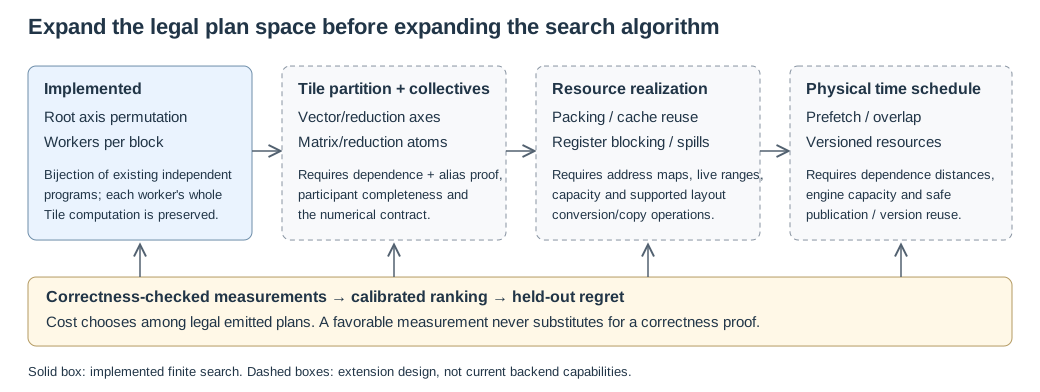
Dashed boxes are planned extensions. Every new search family needs a supported emitter and its own correctness obligations.
New candidate families enter only when their emitters and proof obligations exist. A small space uses exhaustive search. A larger factorized space may use dynamic programming or branch-and-bound; ILP/CP-SAT is useful for discrete resource and dependence constraints; annealing/beam search may propose profitable candidates. Approximate solvers must report budget, explored space and absence of a global guarantee. None is implemented by merely adding the algorithm’s name to a cost model.
Calibration should measure independent mechanisms and retain uncertainty: packet memory coherence, masked work, dispatch batching, arithmetic mix, working sets, duplicated loads/recomputation, live shared values, compile size and spills. Evaluate top-choice regret, top-K coverage and JIT cost on held-out shapes and held-out operator families. Do not fit a GEMM-only model and label it an LLM model. Cache keys must include IR specialization, plan schema, compiler/device identity, numerical policy and cost-model revision; structural transforms invalidate affected plans.
A future Machine TileIR should expose typed realized atoms, execution maps,
resource instances, layouts, lifetimes and synchronization so passes can
inspect and rewrite them. It should not duplicate frontend math or become a
serialized backend instruction list. The current ExecutionPlan and XIR
Module are concrete, smaller stepping stones, not a claim that this full
intermediate representation already exists.
Bounded local-vector candidates
Local-vector distributions remain proposed; snapshots, bounded traversal and closed unordered partials are implemented. The Torch CPU code inspection identified static expansion and dynamic selection chains in the previous bridge’s machine code. The indexable snapshot repair above addresses the selection representation, and bounded traversal removes whole-row static expansion. Neither solves the whole distribution problem: the next candidate family needs independent output/contribution partition factors.
For logical packet width W and p lanes per independent output, p dividing W,
a local candidate maps lane l to (o0 + floor(l/p), r0 + l%p) and advances
r0 = t*p over time. It covers vectorizing across outputs (p=1), across
contributions (p=W), and mixed packing. Physical vector width, output grain,
unroll and scratch choices remain target policy decisions. A phase may use a
different partition from its successor and must account for the transition.
Closed unordered reductions may use partial accumulators and horizontal
combination. Strict folds retain their required contribution order but can
still vectorize independent outputs. Replacing a load snapshot with a view
requires actual alias/effect conditions; parallel supplies independence
between its instances, not permission to change the effect order inside one.
Compiler storage is not a new user Memory obligation.
Cost calibration follows implementation: distinguish gather/contiguous work, vector math, horizontal combine, masks, peak live state and spills, phase transitions and CPU grain. Use separate IR/code-size and JIT budgets to prevent static expansion from overwhelming compilation. Reuse the SIMD backend’s existing fixed-vector math provider. Neither arbitrary lane widening nor a new solver algorithm can substitute for a realizable local-vector family.
8. Validation entry points
test_tile_xir: typed ABI, output verification, repeat lowering, bounds on expansion, unsupported bindings, permutation legality, exact minimum and fixed-plan/budget failure cases; linear snapshot construction, zero SELECTs for proved static projections, exact local-storage boundaries and constant XIR size from width 65 through 16384 for the bounded sumsquares fixture.test_tile_xir_runtime: ragged/transposed GEMM, nonzero initial values, changed non-dyadic inputs, reductions/softmax, offset views, guards, shader moves, zero-trip loops and read/write snapshot recurrences, including dynamically indexed multi-element carry swaps and aliased const/writable buffer arguments; large in-place transpose across Runtime workers and partial-reduction seed/tail/signed-zero/non-closed-fallback checks.test_tile_xir_llm: normalization, activations, RoPE, masked softmax and online prefill/decode/GQA; same capture through XIR and native-target TIRx, each checked independently against an FP64 oracle. Separate large Runtime workspace fixtures bypass the TIRx cross-check but retain full FP64/guards.test_simd_phi_parallel_copy: pure PHI cycles, uniform/varying loops, packet widths 1/2/4/8/16 and every active-lane count, independent of TileIR.benchmark_tile_xir: isolated warm host-wall timing, full output export, realized plan and LLVM identity, with planned/canonical/reversed controls.
These are validation mechanisms, not by themselves performance results. See the status and evidence report for actual runs, limitations and links to raw evidence.